
Ozone Applications

NOx removal with Ozone
Ozone use in NOx Scrubbers
Nitrogen oxides (NO and NO₂, collectively referred to as NOx) are major air pollutants produced by combustion processes in power plants, industrial furnaces, chemical production, and marine engines. NOx contributes to smog, acid rain, and the formation of ground-level ozone, making effective NOx control essential for regulatory compliance and environmental protection.
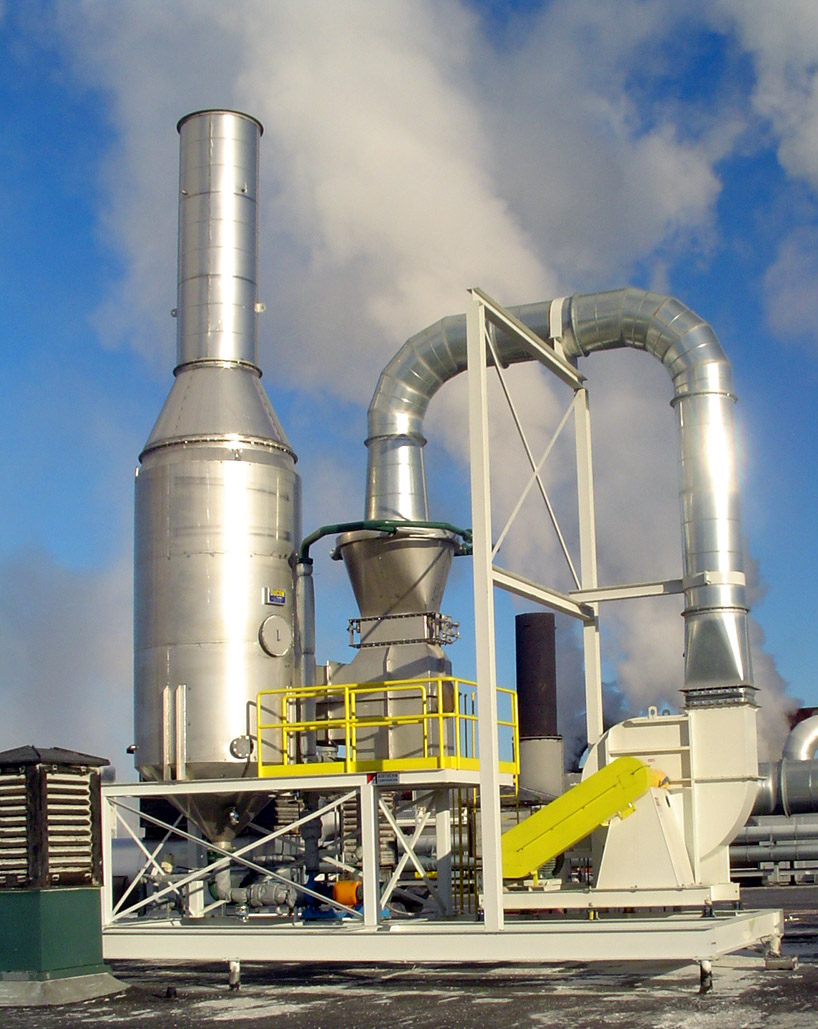
Ozone is a powerful and efficient tool for NOx removal when used in combination with wet scrubber technology. By oxidizing NO to higher oxides, ozone allows for complete absorption and removal in a wet scrubbing system.
Why Use Ozone for NOx Control?
NO is only sparingly soluble in water, which makes it difficult to remove through conventional scrubbing alone. Ozone (O₃), however, rapidly oxidizes NO into NO₂ and higher nitrogen oxides (NO₃, N₂O₅) — species that are highly soluble in water or alkaline solutions and easily removed in the scrubber.
Key Advantages of Ozone-Enhanced NOx Scrubbing:
- Converts insoluble NO to water-soluble NO₂/NO₃
- Achieves high NOx removal efficiencies (>90% achievable)
- Operates at low temperatures without costly reheating
- Reduces or eliminates chemical scrubbing agents (e.g., chlorine or bleach)
- Simple retrofit into existing scrubber systems
- On-site ozone generation — no hazardous chemical storage
- Minimal environmental impact (ozone reverts to oxygen after reaction)
How the Process Works
- Ozone Injection
Ozone is generated on-site and injected into the exhaust gas stream upstream of the scrubber. - Oxidation of NOx
Ozone reacts with NO to form NO₂ and higher nitrogen oxides. This occurs rapidly, even at ambient temperature.2 NO + O₃ → 2 NO₂ + O₂
NO₂ + O₃ → NO₃ + O₂
NO₂ + NO₃ → N₂O₅
- Wet Scrubbing
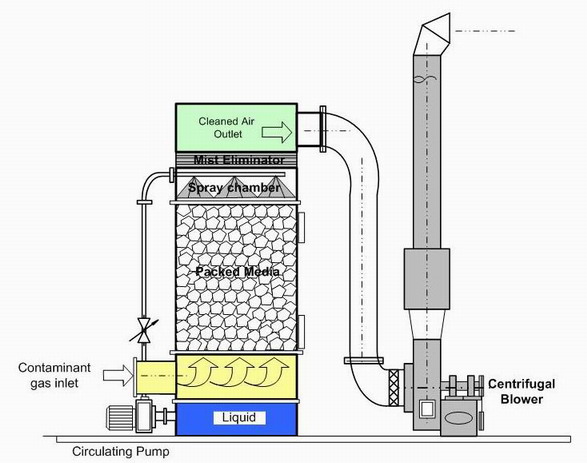
The oxidized NOx compounds are water-soluble and are absorbed in a packed-bed or venturi scrubber using water or an alkaline solution. - Clean Air Discharge
Treated gas exits the scrubber with NOx concentrations well below regulatory limits. - Ozone Decomposition
Any excess ozone naturally decomposes to oxygen, leaving no residual chemicals.
Typical Applications
Ozone-assisted NOx scrubbing is used across multiple industries, including:
- Chemical and fertilizer production
- Refineries and FCC units
- Glass and ceramics manufacturing
- Steel and metal processing
- Power generation facilities
- Marine and shipping exhaust systems
- Waste incineration plants
 |
|
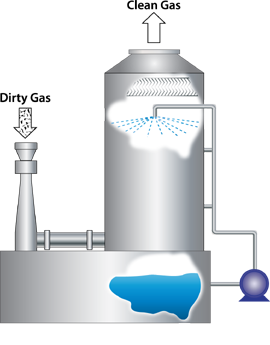
Wet scrubber example. For NOX reduction ozone can be implemented with the incoming gas stream to react directly with nitrogen compounds. |
System Integration Options
Ozone can be added to existing or new scrubber systems. Typical components include:
- Ozone generator sized for required NOx load
- Ozone injection manifold
- Venturi or packed-bed wet scrubber
- Control system for ozone dose and gas monitoring
- Optional ozone destruct unit for residual ozone removal
This retrofit-friendly design allows facilities to upgrade their NOx control systems without costly infrastructure changes.
Performance
Studies and field applications have shown:
- NOx removal efficiencies of 90–99% are achievable
- Ozone-to-NOx molar ratios can be optimized to minimize cost
- The process works at low temperatures without reheating
- Simple operation with minimal operator input
Partner with Oxidation Technologies
Oxidation Technologies specializes in ozone generation systems and NOx scrubbing solutions. We offer:
- Application design and feasibility support
- Ozone system sizing and equipment supply
- Retrofit kits for existing wet scrubbers
- Turnkey ozone + scrubber systems
- Installation, service, and maintenance support
References and Case Studies:
South Coast Air Quality Management District Report:
Summary:
In the report, an ozone system system (which uses ozone injection upstream of a scrubber) is identified as a commercially-available Best Available Retrofit Control Technology for NOₓ control. The key benefits as described in the report include:
-
The process oxidizes NO (which is relatively insoluble and difficult to remove) into higher oxides (NO₂/NO₃/N₂O₅) that are water-soluble, enabling removal using a wet or semi-wet scrubber rather than relying solely on conventional catalytic reduction. A
-
It operates at low temperature, meaning no re-heating of flue gases is required, thereby preserving heat recovery and reducing thermal penalty compared with other NOₓ control systems.
-
It can be integrated with scrubbers already being used for other pollutants (SOₓ, particulate matter), thus providing a multi-pollutant control solution in one system rather than installing separate NOₓ and SOₓ equipment.
-
It avoids the need for ammonia injection (as used in SCR) and the associated risks of ammonia slip and catalyst fouling—making it a potentially simpler, more robust solution in certain applications.
-
Industrial real-world installations cited in the report demonstrate high removal efficiencies: many LoTOx installations (with ozone + scrubber) achieved NOₓ outlet concentrations in the single digits ppmv (e.g., 8-10 ppmv NOₓ in refinery FCCU applications) and control efficiencies up to 90 %+ in various applications.
The report positions the ozone-based LoTOx™ process as a technically viable and cost-effective option for aggressively reducing NOₓ emissions — especially when existing scrubber systems are already in place and when integration of multi-pollutant removal is desired.
Link:
https://www.aqmd.gov/docs/default-source/rule-book/Proposed-Rules/regxx/pdsr-072115.pdf

Marine Emission Pollution Abatement Using Ozone Oxidation by a Wet Scrubbing Method
Authors:
Abstract:
Marine diesel engines produce exhaust gas including a lot of SO2 and NOx. This paper proposes a process that is capable of removing NOx and SO2 simultaneously; this process utilizes ozone oxidation and an alkaline countercurrent packed scrubber. Ozone decomposition, oxidation properties of NOx, and removal efficiency of NOx and SO2 were investigated, and the optimal factors were established. The reaction mechanism and products for simultaneous desulfurization and denitration were deduced. Results show that the ozone decomposition rate depends on exhaust gas temperature and initial concentration of ozone. Oxidation efficiency of NOx decreases as temperature rose and initial concentration of ozone reduced. The presence of SO2 has little influence on NO conversion process. CO(NH2)2 is the best reducing additive to reduce the consumption of ozone. The optimal factors for SO2-reduction and NOx-reduction were achieved, such as temperature of 150 °C, stoichiometric ratio between ozone and NO of 0.6, and pH about of 8 by alkaline absorption. With this method, about 93% NOx and close to 100% SO2 can be removed at same time and regulations of the international maritime organization (IMO) can be met.
Link:
https://pubs.acs.org/doi/abs/10.1021/acs.iecr.6b01038

A Novel Method for Simultaneous Removal of NO and SO2 from Marine Exhaust Gas via In-Site Combination of Ozone Oxidation and Wet Scrubbing Absorption
Authors:
- Zhitao Han
- Tianyu Zou
- Junming Wang
- Jingming Dong
- Yangbo Deng
- Xinxiang Pan
Abstract:
The stringent international regulations on marine emission abatement have exerted a huge push on the development of marine desulfurization and denitrification technologies. However, for the traditional vessels driven by large two-stroke diesel engines, simultaneous removal of NOx and SO2 is still a big challenge at present. Here, a one-stage ozone oxidation combined with in-situ wet scrubbing for simultaneous removal of NO and SO2 is proposed. A series of experiments were performed based on a bench-scale reaction system. The results showed that in-situ wet scrubbing could effectively decrease flue gas temperature, and then suppress the thermal decomposition of ozone, which was beneficial for improve oxidant utilization. Meanwhile, the in-situ combination of ozone injection and wet scrubbing was in favor of improving the selectivity oxidation of NO over SO2 by ozone, which was possibly due to the high aqueous solubility of SO2 in water. Aiming to reduce the electric power consumption by an ozone generating system, O3/NO molar ratio was kept as low as possible. A complete removal of SO2 and a high NOx removal efficiency could be achieved through the introduction of other oxidative additives in scrubbing solution. This integrated system designed for marine application was of great significance.
Link:
https://www.mdpi.com/2077-1312/8/11/943

Lab- and pilot-scale wet scrubber study on the redox-mediated simultaneous removal of NOx and SO2 using a CaCO3-based slurry with KI as a redox catalyst
Authors:
Abstract:
This study presents a novel approach that integrates ozone-driven chemical oxidation to convert NO into soluble NO2, followed by the simultaneous absorption of NO2 and SO2 into a CaCO3-based slurry using the redox catalyst potassium iodide (KI). Using cyclic voltammetry, we demonstrate the redox properties of the I2/2I- couple, which facilitates NO2 reduction into soluble NO2- and catalyst regeneration through sulfite (SO32-)-driven reduction, thus establishing a closed catalytic cycle within the components of flue gas. In lab-scale wet-scrubbing tests, we explore the effect of various operational parameters (i.e., KI concentration, pH, and SO2 concentration), with a 15 h stability test demonstrating >60% NOx and >99% SO2 removal efficiency when the pH is controlled between 7.5 and 8.5. A successful pilot-scale implementation conducted at an inlet flow rate of 1000 m3 h-1 further confirmed the reproducibility of the proposed redox-catalytic cycle. Our study offers a cost-effective, sustainable, and scalable solution for effectively mitigating NOx and SO2 emissions at low temperatures.
Link:
https://pubmed.ncbi.nlm.nih.gov/38548080/

Simultaneous removal of SO 2 and NOx from biomass flue gas
by ozone oxidation + wet scrubbing method
Authors:
2. Key Laboratory of Poyang Lake Environment and Resource Utilization, Ministry of Education, School of Resources Environmental and Chemical Engineering, Nanchang University, Nanchang 330031, China;
3. The Key Laboratory of Water and Air Pollution Control of Guangdong Province,
Guangzhou 510655, China;
Abstract:
In this work, factors affecting NO and SO 2 removal were systematically investigated, including O 3 /NO ratio (V/V), different oxidant types, NaOH and KMnO 4 concentrations. Results indicate that the degree of oxidation cannot be pursued too much and the best O 3 / NO ratio (V/V) is 0.5. The increased amount of KMnO 4 and NaOH promoted the removal efficiency of NOx. The key to the removal of NOx by KMnO4 was mainly that when the KMnO 4 was 0.013 mol / L, the removal efficiency of SO 2 and NOx reached 100% and 93.75%, respectively. This indicates that the technology can not only efficiently remove NO and SO 2 , but also has a great application prospect.
Link: