
Ozone Applications

Ozone use in Wet Scrubbers
A wet scrubber is used to remove pollutants or odors from process exhaust gasses. The purpose of a wet scrubber is to remove pollutants from the air and dissolve them into water for discharge in a wastewater stream.
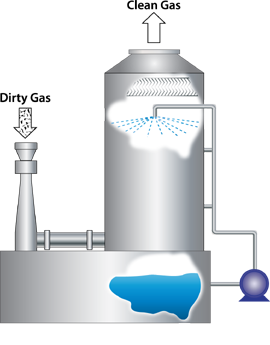
In a wet scrubber, water is sprayed or misted into the air stream to mix with the polluted air. The soluble pollutants in the air will dissolve into the water and be discharged safely in a waste water stream where they can be safely removed or converted to safe compounds.
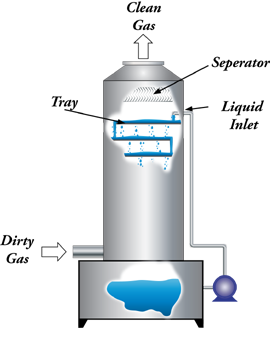
Water used in a wet scrubber may be mixed with Hydrogen Peroxide, Chlorine Dioxide, or a variety of other chemicals to both improve pollution removal efficiency, and to maintain a clean, efficient wet scrubber. These chemicals may bond to pollutants, or convert the pollutant to a safe alternative using chemical reactions.
Ozone can also be used in the wet scrubber to improve wet scrubber efficiency, and reduce chemical costs. Ozone can be used in any wet scrubber where the process of oxidation offers synergistic effects with water. Ozone may directly oxidize pollutants in the dirty gas stream, oxidize contamination on the scrubber walls, or help increase the efficiency of water to trap pollution. While the use of ozone in wet scrubbers is fairly new, the rising costs of chemicals ensures ozone use in wet scrubbers has a very bright future.
Wet scrubbers are a powerful and proven method for removing contaminants from air streams. By integrating ozone into the scrubbing process, facilities can significantly increase oxidation efficiency, reduce chemical costs, and improve overall air quality treatment performance.
Why Ozone?
Ozone is one of the most effective oxidants available. When introduced into a wet scrubber, ozone reacts rapidly with a wide range of contaminants, breaking them down into less harmful or more manageable compounds.
Key benefits of using ozone in wet scrubbers:
- Powerful oxidizer: Quickly destroys VOCs, odors, and reduced sulfur compounds.
- On-site generation: No need to store or handle hazardous chemicals.
- Lower operating cost: Reduces or eliminates the need for liquid chemical oxidants like sodium hypochlorite or hydrogen peroxide.
- Environmentally friendly: Converts back to oxygen after use, leaving no residual chemical byproducts either in the effluent air or discharged water.
- Effective for difficult contaminants: Handles compounds that may be only partially treated by traditional scrubbing solutions.
- Promotes efficient scrubber operation: Ozone will oxidize organics that may build up in the tower packing or walls ensuring more efficient scrubber operation.
How It Works
- Ozone Generation – Ozone is produced on-site using an ozone generator and injected directly into the wet scrubber system.
- Contact and Reaction – As the contaminated gas stream passes through the scrubbing liquid, ozone dissolves into the solution and oxidizes target compounds.
- Contaminant Breakdown – VOCs, H₂S, mercaptans, ammonia, and other compounds are destroyed or transformed into non-odorous, more stable byproducts.
- Clean Air Discharge – The treated air exits the scrubber with significantly reduced contaminant levels.
- Ozone Decomposition – Any residual ozone naturally decomposes to oxygen, ensuring safe operation and minimal environmental impact.
Typical Applications
Ozone-enhanced wet scrubbers are used across a wide range of industries and odor control systems, including:
- Wastewater treatment plants (H₂S and odor control)
- Industrial exhaust treatment
- Chemical manufacturing and processing
- Rendering and food processing facilities
- Composting and organic waste handling
- Landfill gas and leachate treatment facilities
- NOx scrubbers
Advantages Over Traditional Chemical Scrubbing
|
Traditional Chemical Scrubbing |
Ozone-Enhanced Scrubbing |
|
Requires ongoing purchase and handling of chemicals |
Ozone generated on-site, no chemical storage |
|
Generates secondary waste streams |
Minimal residuals—ozone breaks down to oxygen |
|
Limited oxidation power |
High oxidation potential—effective on a wider range of compounds |
|
Higher operational costs |
Reduced operating and maintenance costs |
The Ozone Solution:
Ozone can be dissolved into the makeup water flowing into the wet scrubber, dissolved into water as it flows to the spray nozzles, or injected directly into the air stream. Depending upon the goals and ozone reactions we can help design the right system for your specific application.
Ozone use in Odor Control Wet Scrubbers
Odor control wet scrubbers are commonly used for H2S removal, and other odorous compounds from rendering plants, fertilizer manufacturers, or other odor causing processes. Ozone is commonly used as a method to remove odor in other applications. Ozone is a great method of removing odor in a wet scrubber as ozone is a great method to remove odor, and ozone with water provides great synergistic effects. Odor control wet scrubbers commonly have bio fouling and slime forming inside the scrubber tower. Ozone slows this growth and removes this biological growth increasing the efficiency of the wet scrubber.
Ozone use in VOC Wet Scrubbers
VOC wet scrubbers are used to remove Volatile Organic Compounds (VOC's) or convert VOC's to CO2. Sometimes VOC scrubbers are refereed to as CO2 scrubbers. A common use of VOC scrubbers is Ethanol plants. Ozone is very effective at converting VOC's into CO2 by bonding with the carbon atom in the complex VOC molecules. When ozone is used within a wet scrubber ozone and water are used together with great efficiency to oxidize VOC's and other hazardous gasses.
Ozone use in NOx Scrubbers
Ozone is used in NOx scrubbers to eliminate nitrogen oxides from gas streams by converting NO into NO2 and higher nitrogen oxides that are highly soluble in water to be removed in the scrubber. See our separate info page for additional inforamtion here.
Partner with Oxidation Technologies
Our team specializes in ozone system design, integration, and support for air and water treatment applications. We can assist with:
- Application design and feasibility studies
- Ozone generator sizing and selection
- Retrofit solutions for existing wet scrubber systems
- Turn-key ozone scrubber solutions
- Ongoing maintenance, service, and optimization
Contact Oxidation Technologies
References and Case Studies:
Treatment of VOCs with a wet scrubbing - catalytic ozonation process: Efficiency mechanism and pilot-scale application
Authors:
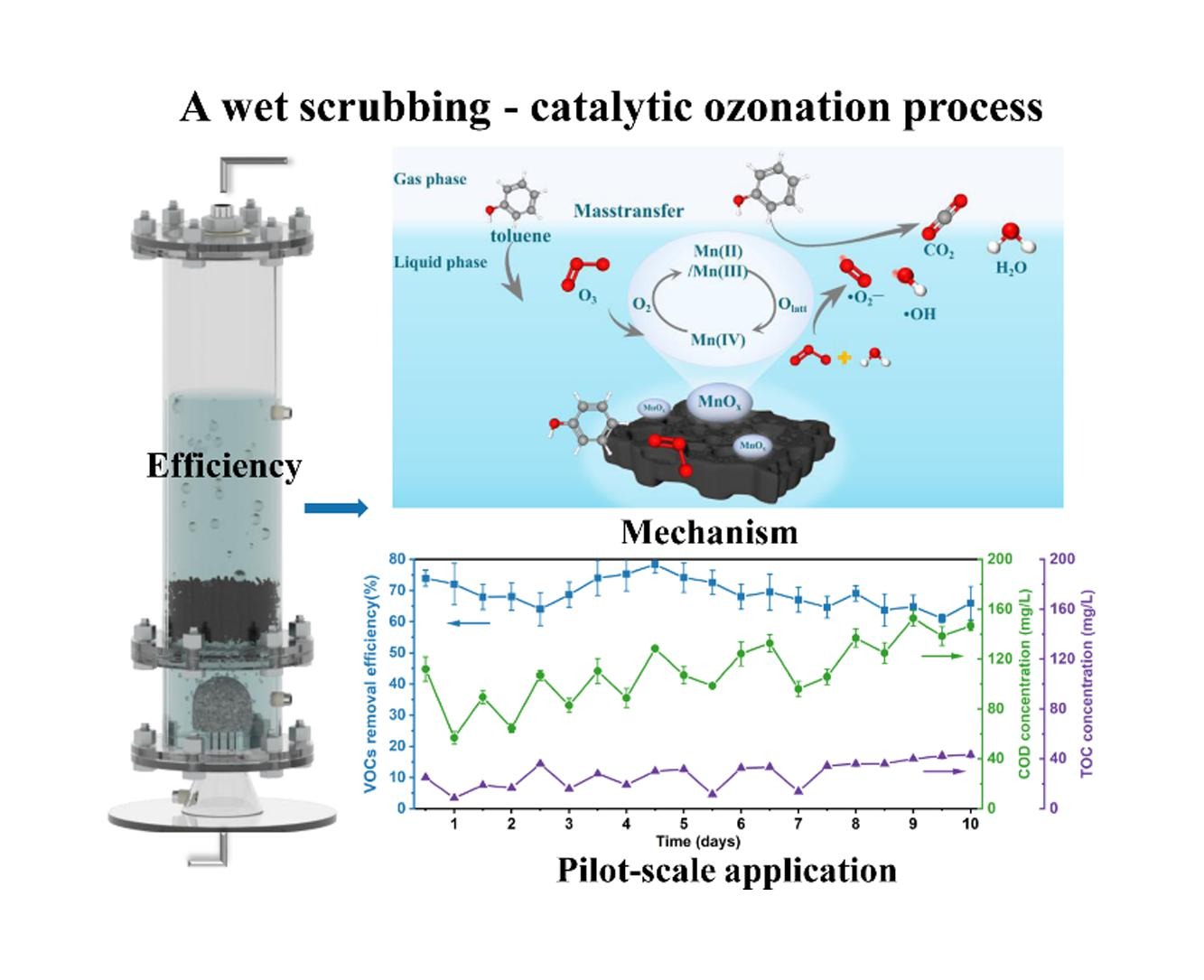
A wet scrubbing – catalytic ozonation (WCO) process with activated carbon (AC) loaded MnOx (MnOx/AC) as the catalyst was developed, based on volatile organic compounds (VOCs) can be efficiently removed. The mineralization efficiency, degradation pathway and mechanism, and effects of the process operating parameters were investigated in detail using toluene as the target pollutant. The results show that the average removal efficiency of toluene reached 71.82 % within 90 min under optimal conditions (CToluene = 100 mg/m3; CO3 = 1 mg/L; catalyst loading = 5 g/L; pH = 7; gas flow = 500 mL/min), which outperformed that of the gaseous system. Quenching experiments and electron spin resonance spectroscopy indicate that  OH and O2− are the two main reactive oxygen species (ROSs) in the system, which facilitate the opening of the benzene ring and significantly reduce by-products. The intermediates of toluene degradation were identified by proton-transfer reaction time-of-flight mass spectroscopy (PTR-TOF-MS). The results indicate that most of the intermediates generated in the system are captured in water rather than being emitted into the atmosphere. In the pilot-scale experiments, the WCO process exhibited a stable VOC removal efficiency (≥61.05 %) for 10 d in the treatment of actual low-concentration VOCs. Therefore, in this study, an effective process for the removal of low-concentration VOCs is proposed, which can be used for multiple VOC treatments.
Graphical Abstract:
Link:
https://www.sciencedirect.com/science/article/abs/pii/S1383586623031313?via%3Dihub

Degradation of gaseous volatile organic compounds (VOCs) by a novel UV-ozone technology
Authors:
In this study, a UV-assisted ozonation (UV/O₃) process for the degradation of VOC emissions, combined with a final scrubbing phase, was implemented to evaluate the removal efficiency of toluene and to prevent the release of polluting intermediates produced in the single-step process. The inlet toluene concentration and applied voltage were varied to investigate several operating conditions.
The results highlighted that higher inlet concentrations led to lower toluene abatement, while an increase in ozone concentration improved degradation efficiency. The additional water scrubbing step enhanced the performance of the UV/O₃ process up to 98.5% removal efficiency, due to the solubilization of ozone and by-products in the process water and the subsequent further oxidation of contaminants in this phase.
A maximum elimination capacity (ECₘₐₓ) of 22.6 g·m⁻³·h⁻¹ was achieved with the combined UV/O₃ + scrubbing system. This integrated approach demonstrated higher performance and stability compared to the stand-alone UV/O₃ process, along with improved economic and environmental sustainability.
Link:
Study Summary
This study investigates a UV-assisted ozonation process (UV/O₃) combined with a final water-scrubbing phase for the degradation of toluene, a representative volatile organic compound (VOC) commonly emitted from industrial sources. The combined system was designed to improve VOC removal efficiency while minimizing the release of harmful oxidation by-products typically associated with standalone UV/O₃ processes.
Experiments were conducted using a pilot-scale reactor developed by the SEED Laboratory at the University of Salerno. The reactor integrates ozone-generating UV lamps (185 nm) with a downstream wet scrubber. Operational parameters such as inlet toluene concentration and ozone dosage (via lamp voltage) were systematically varied.
Key Findings and Insights
-
Enhanced VOC removal:
The combined UV/O₃ + Scrubbing system achieved up to 98.5 % toluene removal, significantly outperforming the standalone UV/O₃ process. -
Elimination capacity:
A maximum ECₘₐₓ of 22.6 g m⁻³ h⁻¹ was recorded, demonstrating strong treatment capacity under optimized conditions. -
Effect of inlet concentration:
-
Higher inlet toluene concentrations led to reduced removal efficiency for the single-stage UV/O₃ system.
-
The addition of a scrubbing phase maintained high removal (> 80 %) even at elevated VOC loads (up to 600 ppm).
-
-
Effect of ozone dosage:
Increased voltage (more UV lamps activated) raised ozone production, enhancing toluene oxidation.
However, excess ozone in the gas phase could scavenge hydroxyl radicals, slightly lowering performance at extreme doses. -
Role of the wet scrubber:
-
Dissolved ozone and by-products in the scrubbing water enabled further oxidation in the liquid phase.
-
The scrubber also reduced residual ozone emissions to < 3 %, improving environmental safety.
-
Enhanced system stability and energy efficiency were observed relative to UV/O₃ alone.
-
-
Reaction mechanism:
Hydroxyl radicals generated by UV-ozone photolysis are the dominant oxidants.
The scrubbing step supports aqueous-phase oxidation, converting aromatic VOC intermediates into less reactive acids and alcohols (e.g., formic, acetic, benzoic acids).
Practical Implications
-
The hybrid UV/O₃ + scrubbing configuration effectively treats gaseous VOCs and odorous emissions with lower secondary pollution risk.
-
Retrofitting existing scrubbers with upstream UV/O₃ reactors could be an efficient, low-chemical-consumption upgrade.
-
Suitable for industrial exhausts (e.g., paint, printing, petrochemical, or wastewater treatment facilities) where VOC/odor emissions require compliance with strict air-quality limits.
Link to full paper:
VOC Emissions from a Rendering Plant and Evaluation for Removal of Pentanal by Oxidization Using Hydrogen Peroxide
Authors:
Rendering plants process dead livestock to produce grease and bone meal. In such facilities, the cooking and drying operations are the primary sources of odor emissions. The use of non-fresh livestock reduces the efficiency of odor control systems, and in Taiwan, where rendering plants typically operate under batch-feeding conditions, significant volatile organic compound (VOC) emissions occur in the exhaust gas—often leading to odor complaints from nearby communities.
This study evaluated the removal efficiencies of pentanal, hexanal, and toluene—common VOCs found in rendering exhaust—using ozone and hydrogen peroxide as oxidizing agents. Experimental results showed that ozone was ineffective in reducing aldehydes and toluene concentrations, and that residual ozone in the exhaust gas acted as a secondary air pollutant, irritating human respiratory tracts.
In contrast, hydrogen peroxide effectively removed pentanal, demonstrating its feasibility as a VOC treatment oxidant when applied within a contact reactor. When the pentanal concentration from the rendering process was approximately 36.23 ppm in the flue gas, with flow rates ranging from 100 to 250 Nm³·min⁻¹, the first-order reaction rate constant for pentanal oxidation by aqueous hydrogen peroxide (1,000 mg·L⁻¹) was determined to be 0.536 s⁻¹. Under these conditions, pentanal concentrations were reduced to 0.68–2 ppm.
Based on simulations using a Gaussian dispersion model, the resulting pentanal emission rate was estimated to be below 0.01 g·s⁻¹, a level unlikely to cause odor complaints from surrounding residents.
Link to full paper:

Marine Emission Pollution Abatement Using Ozone Oxidation by a Wet Scrubbing Method
Authors:
Abstract:
Marine diesel engines produce exhaust gas including a lot of SO2 and NOx. This paper proposes a process that is capable of removing NOx and SO2 simultaneously; this process utilizes ozone oxidation and an alkaline countercurrent packed scrubber. Ozone decomposition, oxidation properties of NOx, and removal efficiency of NOx and SO2 were investigated, and the optimal factors were established. The reaction mechanism and products for simultaneous desulfurization and denitration were deduced. Results show that the ozone decomposition rate depends on exhaust gas temperature and initial concentration of ozone. Oxidation efficiency of NOx decreases as temperature rose and initial concentration of ozone reduced. The presence of SO2 has little influence on NO conversion process. CO(NH2)2 is the best reducing additive to reduce the consumption of ozone. The optimal factors for SO2-reduction and NOx-reduction were achieved, such as temperature of 150 °C, stoichiometric ratio between ozone and NO of 0.6, and pH about of 8 by alkaline absorption. With this method, about 93% NOx and close to 100% SO2 can be removed at same time and regulations of the international maritime organization (IMO) can be met.
Link:
https://pubs.acs.org/doi/abs/10.1021/acs.iecr.6b01038

A Novel Method for Simultaneous Removal of NO and SO2 from Marine Exhaust Gas via In-Site Combination of Ozone Oxidation and Wet Scrubbing Absorption
Authors:
- Zhitao Han
- Tianyu Zou
- Junming Wang
- Jingming Dong
- Yangbo Deng
- Xinxiang Pan
Abstract:
The stringent international regulations on marine emission abatement have exerted a huge push on the development of marine desulfurization and denitrification technologies. However, for the traditional vessels driven by large two-stroke diesel engines, simultaneous removal of NOx and SO2 is still a big challenge at present. Here, a one-stage ozone oxidation combined with in-situ wet scrubbing for simultaneous removal of NO and SO2 is proposed. A series of experiments were performed based on a bench-scale reaction system. The results showed that in-situ wet scrubbing could effectively decrease flue gas temperature, and then suppress the thermal decomposition of ozone, which was beneficial for improve oxidant utilization. Meanwhile, the in-situ combination of ozone injection and wet scrubbing was in favor of improving the selectivity oxidation of NO over SO2 by ozone, which was possibly due to the high aqueous solubility of SO2 in water. Aiming to reduce the electric power consumption by an ozone generating system, O3/NO molar ratio was kept as low as possible. A complete removal of SO2 and a high NOx removal efficiency could be achieved through the introduction of other oxidative additives in scrubbing solution. This integrated system designed for marine application was of great significance.
Link:
https://www.mdpi.com/2077-1312/8/11/943.com