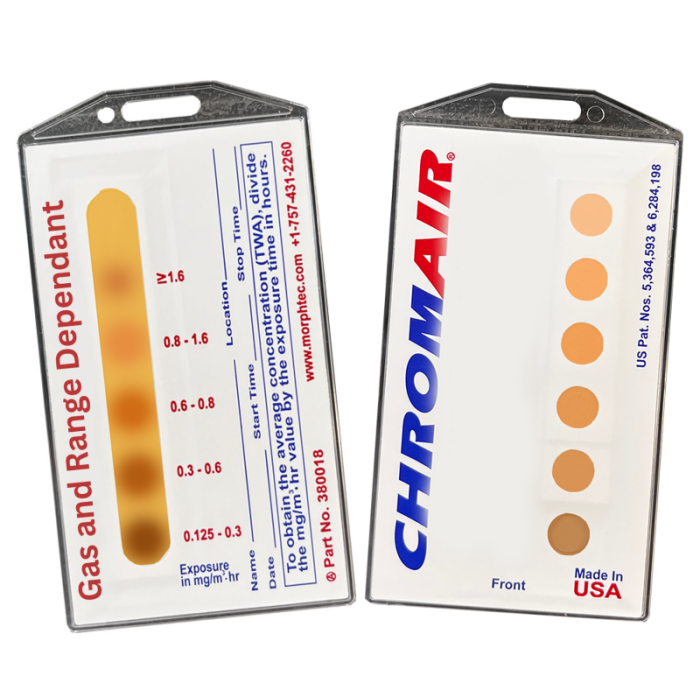
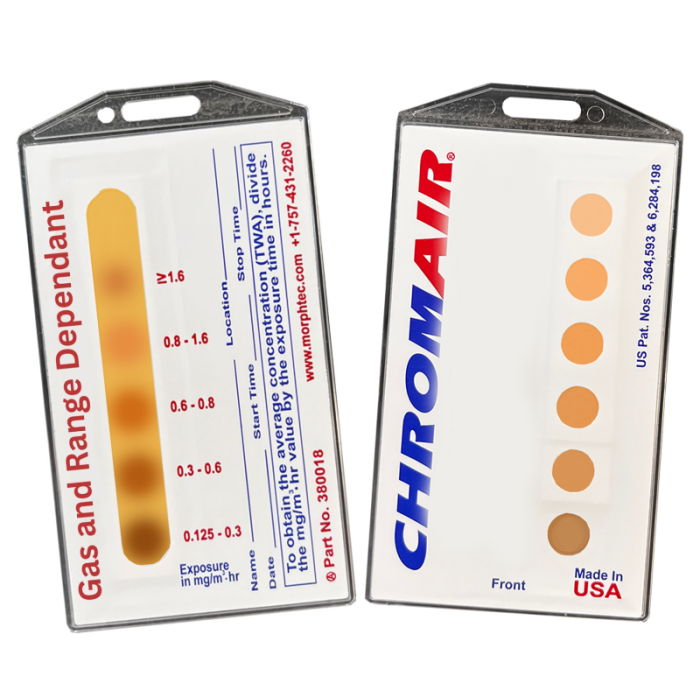
The ChromAir chemical exposure badge provides a color-indicating, easy-to-use solution for monitoring ozone exposure in personnel or workplace environments. Designed for quick visual checks, the badge is ideal for maintaining safety compliance in laboratories, industrial facilities, and other ozone-handling applications.
How It Works
The ChromAir ozone badge uses a passive, direct-read chemical exposimeter. Ozone exposure causes a color change from blue to white, allowing users to easily determine the exposure dose.
- Personnel monitoring: Suitable for exposure times from 5 minutes to 10 hours
- Area monitoring: Effective for tracking ozone concentrations in workspaces
Introduction to Ozone
Ozone is a bluish gas with a characteristic odor at concentrations below 2 ppm. At higher levels, it can be pungent and irritating, posing risks to the eyes and respiratory system.
Health Risks:
- Severe irritation to eyes and mucous membranes
- Long-term exposure can cause pulmonary edema and chronic respiratory disease
- OSHA and NIOSH exposure limit: 0.1 ppm (TWA)
Applications of Ozone:
- Air and water disinfection
- Bleaching of waxes, textiles, and oils
Principle of Operation
The ChromAir badge contains six chemical cells connected to a flat indicator layer on one side and diffusive resistances on the other.
- Ozone diffuses through the resistances to the indicator layer
- Exposure causes a color change, which correlates with the exposure dose (ppm•hr)
- A direct-read color comparison allows users to measure exposure quickly and accurately
Additional Tools: For higher resolution or accuracy, a color comparator is available for certain chemicals like carbon monoxide, formaldehyde, and mercury.
How to Use the ChromAir Badge
- Remove the badge from its refrigerated pouch and allow it to reach room temperature.
- Enter relevant information on the I.D. label (name, location, date, start time).
- Remove the protective strip from the first cell.
- Personnel monitoring: Attach near the user’s breathing zone (e.g., collar).
- Area monitoring: Mount in a central location with the front side exposed.
- Check the back periodically to view the exposure dose (ppm•hr).
Example: If a 2-hour sampling period reads 10 ppm•hr, the average ozone concentration is 5 ppm.
Storage
To maintain accuracy and reliability:
- Keep the badge refrigerated in its sealed bag until use
The Ozone ChromAir Badge is a reliable, easy-to-read solution for keeping personnel and workplaces safe from ozone exposure. Its simplicity, combined with precise color-based monitoring, makes it an essential tool for any facility handling ozone.
You can find this product here: https://www.oxidationtech.com/ozone-chromair-badge-380010-10.html