Ozone Applications
AOP
Advanced Oxidation Processes (AOP) for Water Treatment
Advanced Oxidation Processes (AOP) are water treatment technologies that generate highly reactive oxidizing compounds, primarily hydroxyl radicals (•OH), to break down organic contaminants and other difficult-to-treat substances in water.
AOP technologies are commonly used when conventional water treatment methods, including filtration, biological treatment, and traditional chemical oxidation, cannot achieve the desired contaminant removal.
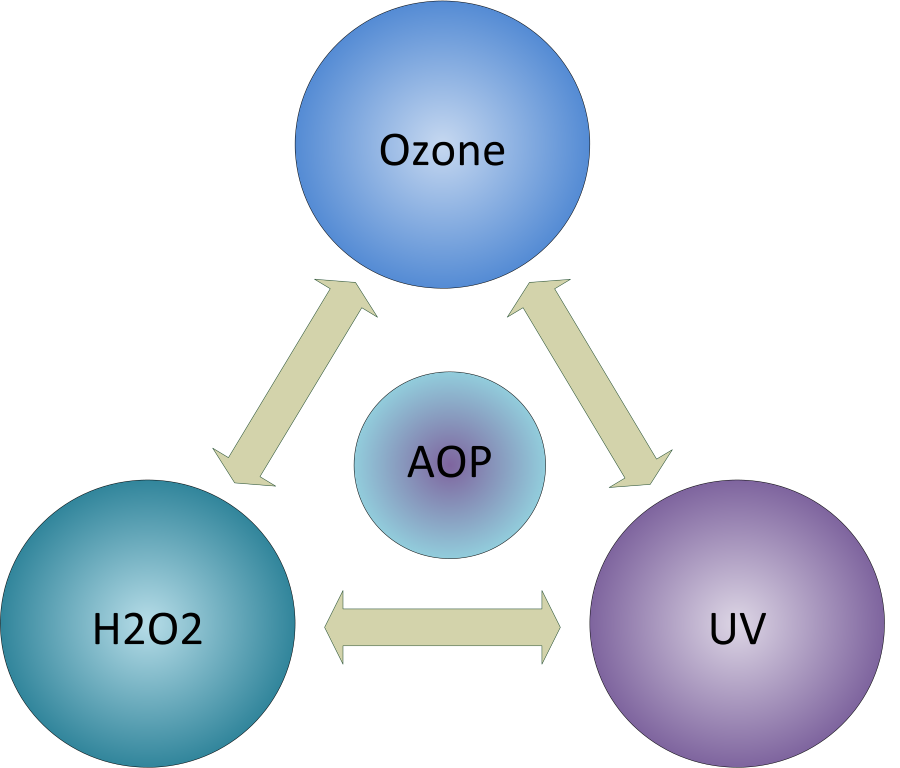
Advanced oxidation is traditionally accomplished using ozone, ultraviolet (UV) light, hydrogen peroxide (H₂O₂), or combinations of these technologies.
What Is the Hydroxyl Radical?
The hydroxyl radical (•OH) is one of the most powerful oxidizing species used in water treatment.
Hydroxyl radicals have a standard oxidation potential of approximately 2.80 volts, compared to 2.07 volts for ozone and 1.36 volts for chlorine gas.
This high oxidation potential allows hydroxyl radicals to oxidize a wide range of compounds, including some that react slowly, or not at all with conventional oxidizers.
Unlike ozone or hydrogen peroxide, hydroxyl radicals are extremely short-lived. They react almost immediately with nearby substances and do not produce a lasting disinfectant residual or directly measurable value. Only the resulting reactions or potentially ORP increases in water are directly measured to quantify hydroxyl radical creation.
Hydroxyl radicals are particularly useful for breaking down difficult organic contaminants, and vary stable but oxidizable compounds without requiring a persistent oxidant residual in the treated water.
Oxidation Potential Comparison
|
Oxidizing Agent |
Oxidation Potential |
|
Hydroxyl Radical (•OH) |
2.80 V |
|
Ozone (O₃) |
2.07 V |
|
Hydrogen Peroxide (H₂O₂) |
1.78 V |
|
Chlorine (Cl₂) |
1.36 V |
Values represent commonly cited standard reduction potentials for specific acidic half-reactions.
Learn More About Oxidation Potential
How Advanced Oxidation Processes are Created
Several technologies can be used to generate hydroxyl radicals in water. The most common methods are
|
O₃/UV |
Ozone + UV |
|
H₂O₂/UV |
Hydrogen peroxide + UV |
|
O₃/H₂O₂ |
Ozone + hydrogen peroxide |
1. Ozone + UV Light (O₃/UV)
Combining ozone dissolved in water with ultraviolet light is the most common method of generating hydroxyl radicals in water.
When ozone-containing water passes through a UV treatment system, UV energy accelerates ozone decomposition and promotes reactions that generate hydroxyl radicals.
O₃ + H₂O + UV → H₂O₂ + O₂
Then:
2 O₃ + H₂O₂ → 2 •OH + 3 O₂
This process offers several potential benefits:
-
-
-
- Combines ozone oxidation with hydroxyl radical oxidation.
- Can provide UV disinfection simultaneously.
- Can reduce or eliminate dissolved ozone residuals downstream.
- Does not require the addition of hydrogen peroxide or any other chemicals (no chemical storage, handling, transport)
- Can be integrated into existing ozone treatment systems.
- Requires only electrical power for operation → the most environmentally friendly option
-
-
The effectiveness of UV/Ozone AOP depends on dissolved ozone concentration, UV dosage, water chemistry, and the target contaminants.
Learn More: UV Light and Ozone for Advanced Oxidation
2. UV Light + Hydrogen Peroxide (UV/H₂O₂)
Another AOP method combines ultraviolet light with hydrogen peroxide.
When hydrogen peroxide absorbs UV energy, it can split into two hydroxyl radicals.
H₂O₂ + UV → 2 •OH
These radicals rapidly react with susceptible organic contaminants.
UV/H₂O₂ is used in drinking water treatment, industrial wastewater treatment, and water reuse applications.
Advantages include:
-
-
-
- Effective treatment of certain difficult organic contaminants.
- No ozone generation equipment required.
- Controllable hydrogen peroxide and UV dosage rates.
- Established applications in municipal and industrial water treatment.
-
-
However, hydrogen peroxide must be stored and dosed into the water. Residual hydrogen peroxide may also require removal after treatment. Water PH may be altered due to the H2O2 addition to water.
Learn More: UV/Hydrogen Peroxide Advanced Oxidation
3. Ozone + Hydrogen Peroxide (O₃/H₂O₂)
The combination of ozone and hydrogen peroxide may also be referred to as Peroxone.
Adding hydrogen peroxide to ozone-containing water accelerates ozone decomposition through a series of reactions that promote hydroxyl radical formation.
2 O₃ + H₂O₂ → 2 •OH + 3 O₂
Unlike UV-based AOP systems, Peroxone does not require ultraviolet light.
Potential advantages include:
-
-
-
- Increased hydroxyl radical production compared with conventional ozonation under suitable conditions.
- No UV reactor required.
- Can be incorporated into existing ozone treatment systems.
- Useful for application where was it not flowing, such as ground water contamination. Ozone gas can be bubbled/sparged into a well along with a liquid drip of H2O2 to create the AOP reactions in the contaminated groundwater
-
-
The proper ozone-to-hydrogen-peroxide ratio is important. Excess hydrogen peroxide can consume hydroxyl radicals and reduce treatment efficiency. Dosage rates of H2O2 vs O3 are very challenging making this the most difficult to control AOP reactions.
Learn More: Ozone and Hydrogen Peroxide (Peroxone)
4. Ozone + UV + Hydrogen Peroxide
Ozone, UV light, and hydrogen peroxide can also be combined into a single AOP treatment process.
This approach provides multiple pathways for hydroxyl radical generation.
However, adding more oxidants does not necessarily produce better treatment results. The effectiveness depends on the target contaminant, UV dose, oxidant concentrations, and water chemistry.
These systems may be considered for specialized applications where additional treatment flexibility is beneficial.
5. Ozone Alone
Ozone dissolved in water also does result in hydroxyl radicals through its natural decomposition reactions. Higher dissolved ozone levels in water will result in higher rates of hydroxyl radical formation.
The rate of hydroxyl radical formation depends on several factors, including water pH, dissolved ozone concentration, and other substances present in the water.
Consequently, conventional ozone treatment can involve both direct oxidation by molecular ozone and indirect oxidation through hydroxyl radicals.
However, simply adding ozone to water does not necessarily create the same hydroxyl radical exposure as an intentionally designed AOP system.
6. Ozone Nanobubbles for Advanced Oxidation (AOP)
Ozone nanobubble technology is an emerging method of generating hydroxyl radicals (•OH) for advanced oxidation water treatment.
Nanobubbles are extremely small gas bubbles, typically less than 1 micrometer in diameter. Their small size and large surface-area-to-volume ratio can improve ozone transfer into water and promote chemical reactions at the gas-water interface.
Research has demonstrated that ozone nanobubbles can enhance hydroxyl radical generation compared with conventional ozone injection systems. One 2025 study reported a 120% increase in hydroxyl radical concentration using ozone nanobubbles compared with conventional ozonation under the tested conditions. [sciencedirect.com]
Potential benefits include:
-
-
-
- Improved ozone dissolution and gas transfer efficiency.
- Enhanced hydroxyl radical generation under suitable conditions.
- Oxidation of certain organic contaminants that react slowly with molecular ozone.
- Potential AOP treatment without adding hydrogen peroxide or using UV light.
- Integration with existing ozone generation equipment.
-
-
Unlike traditional ozone/hydrogen peroxide or UV-based AOP systems, ozone nanobubbles may promote additional hydroxyl radical formation through reactions occurring at the nanobubble surface.
However, the effectiveness of this process depends on water chemistry, ozone concentration, bubble characteristics, and operating conditions. Research is ongoing to better understand and quantify these benefits.
Learn More: Ozone Nanobubbles
https://www.oxidationtech.com/applications/water-treatment/ozone-nanobubbles.html
7. Other Advanced Oxidation Technologies (not using ozone)
Additional methods of generating highly reactive oxidizing species include:
-
-
-
- Fenton Oxidation: Uses hydrogen peroxide and iron catalysts to generate hydroxyl radicals.
- Photo-Fenton Oxidation: Combines UV or visible light with Fenton chemistry to increase radical production.
- Photocatalytic Oxidation: Uses UV light and catalysts such as titanium dioxide (TiO₂) to generate reactive species.
- Persulfate-Based AOP: Uses activated persulfate compounds to generate sulfate radicals and, under some conditions, hydroxyl radicals.
- Electrochemical AOP: Uses electrical energy and specialized electrodes to generate reactive oxidizing species.
-
-
These technologies are used in specialized industrial wastewater treatment, groundwater remediation, and other applications.
Applications for Advanced Oxidation Processes
AOP technologies are used to treat contaminants that may be difficult to remove using conventional treatment methods.
Potential applications include:
-
- Industrial wastewater treatment
- Drinking water treatment
- Water reuse and recycling
- Pharmaceutical and personal care product residues
- Pesticides and herbicides
- Certain solvents and industrial chemicals
- Taste and odor compounds
- Certain emerging contaminants
- In-Situ Groundwater remediation
- Pump and Treat Groundwater remediation
- Reduction of selected refractory organic compounds
Choosing the Right Advanced Oxidation Process
Selecting the proper AOP technology requires evaluating several factors:
-
- Target contaminants: Different contaminants respond differently to ozone, UV light, and hydroxyl radicals.
- Water quality: pH, alkalinity, organic matter, and UV transmittance affect performance.
- Treatment objectives: Required contaminant removal determines the necessary treatment intensity.
- Operating costs: Electricity, oxidant consumption, and maintenance affect long-term costs.
- Existing equipment: Facilities already using ozone or UV treatment may be able to incorporate AOP without replacing their entire treatment system.
In some applications, ozone alone may provide sufficient treatment. In others, combining ozone with UV light or hydrogen peroxide can provide additional oxidation capabilities.
Bench-scale or pilot testing may be necessary to determine the most effective and economical approach.
Advanced Oxidation Equipment and System Design
Oxidation Technologies supplies ozone generation equipment, UV treatment systems, and supporting equipment for advanced oxidation applications.
We can assist with evaluating treatment requirements, selecting appropriate equipment, and integrating ozone and UV technologies into new or existing water treatment systems.
Contact Oxidation Technologies to discuss your advanced oxidation water treatment application.
https://www.oxidationtech.com/contact-us
Summary and Helpful tips
1. AOP is not simply a stronger version of ozone.
Hydroxyl radicals react differently from molecular ozone. Their value comes from their high reactivity and ability to attack contaminants that may be resistant to direct ozone oxidation.
2. More hydroxyl radicals do not automatically mean better treatment.
Natural organic matter, carbonate, bicarbonate, and other constituents can consume radicals before they react with the target contaminants.
3. Ozone/UV offers an important advantage for certain applications.
Unlike UV/H₂O₂, an ozone/UV system can generate hydroxyl radicals without storing and dosing liquid hydrogen peroxide. This is worth highlighting for industrial customers already using ozone.