The effective removal of contaminants from water is crucial for maintaining environmental health and safety. Two key indicators of water pollution are Chemical Oxygen Demand (COD) and Total Organic Carbon (TOC). These parameters represent the presence of organic pollutants and overall organic load in water, respectively. One powerful method to reduce these contaminants is through the use of ozone.
The Power of Ozone
Ozone (O₃) is a potent oxidant that reacts with both organic and inorganic compounds found in water. This makes it an extremely effective tool for reducing both COD and TOC levels. As ozone breaks down contaminants, it enhances water quality and makes it safer for various applications, from industrial processes to wastewater treatment.
How Ozone Works
Ozone’s strong oxidative properties allow it to break down complex organic molecules and other oxidizable compounds in water. However, because COD and TOC can vary greatly in their chemical composition, there is no fixed stoichiometric ratio or dosage rate of ozone that will eliminate these contaminants universally. The presence of other oxidizable substances in water also influences the amount of ozone required.
Tailored Solutions from Oxidation Technologies
At Oxidation Technologies, we provide customized systems for the removal of COD and TOC in a wide range of applications. We recognize that each water treatment scenario is unique, and we offer a variety of services to determine the optimal ozone system for your specific needs. Our services include equipment rentals, bench-testing, pilot testing, and comprehensive engineering assistance.
In-House Bench Testing Results
We recently conducted in-house bench testing for a customer to demonstrate the efficacy of ozone in reducing COD and TOC. Below is a summary of our findings:
| Sample | COD (mg/l) | TOC (mg/l) |
|---|---|---|
| Control | 530 | 218 |
| Sample #1 | 530 | 202 |
| Sample #2 | 460 | 200 |
| Sample #3 | 350 | 171 |
| Sample #4 | 270 | 135 |
| Sample #5 | 221 | 99.2 |
Testing Procedure
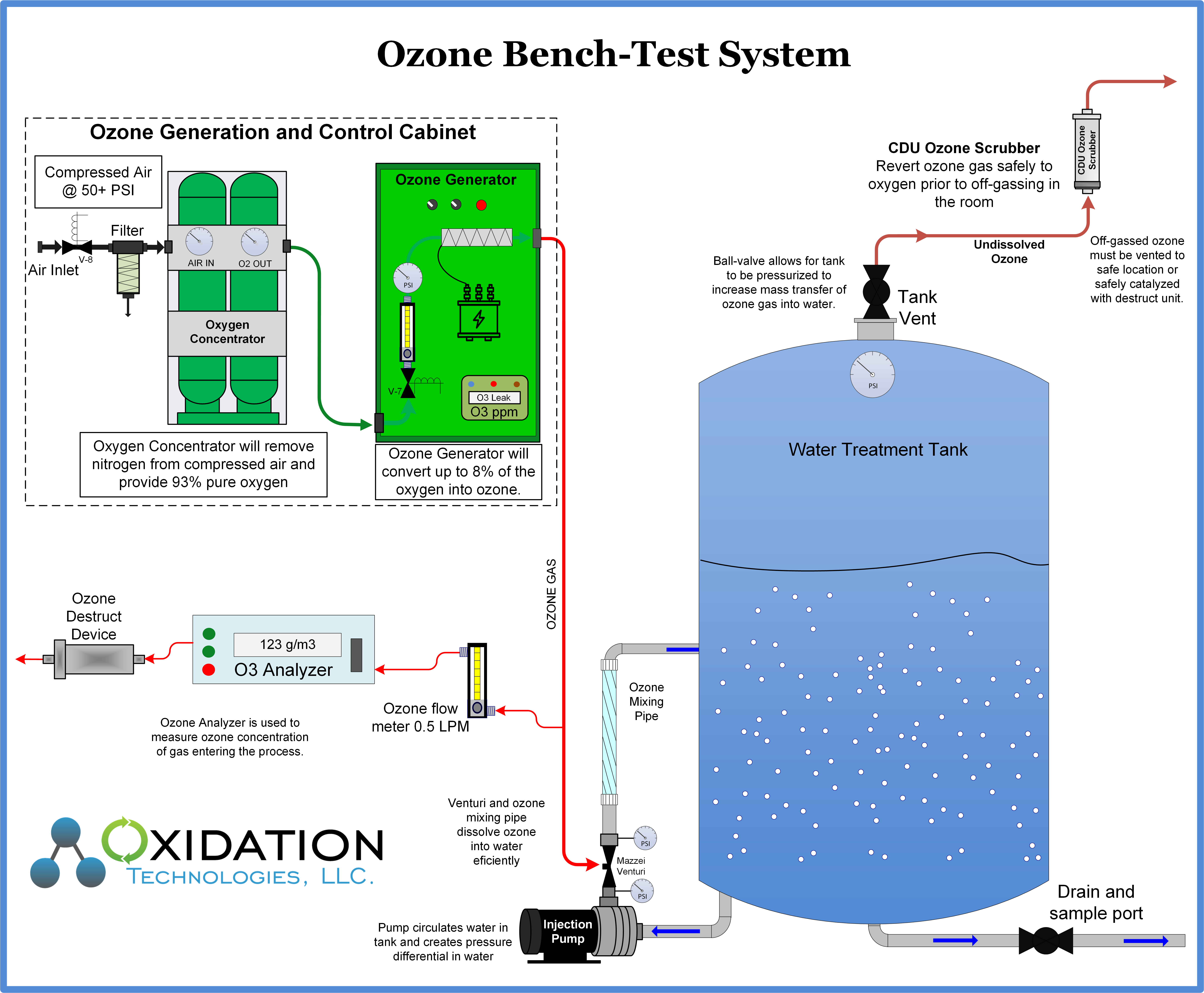
We used a small ozone injection system with a 40-liter water tank. Ozone was introduced into the water using a pump and venturi over a period of 150 minutes. Samples were taken every 30 minutes to monitor the changes in COD and TOC levels.
System Setup
The system used a pressurized tank with a 95-liter capacity, filled with 40 liters of sample water. We circulated this water using a WP-2 pump and a 584 Mazzei venturi to efficiently dissolve ozone gas into the water. An ozone analyzer was used to measure real-time ozone concentration and calculate the dosage rate. This analyzer can also measure ozone off-gas to calculate ozone consumption rates.
Below is a chart detailing the ozone dosage rates during our testing:
| Time (minutes) | Sample size (liters) | Oxygen Flow (LPM) | Ozone concentration (g/m³) | Mass Transfer efficiency | Ozone dosage (mg/l) |
|---|---|---|---|---|---|
| 30 | 40 | 4 | 40 | 80.00% | 96 |
| 60 | 40 | 4 | 40 | 80.00% | 192 |
| 90 | 40 | 4 | 40 | 80.00% | 288 |
| 120 | 40 | 4 | 40 | 80.00% | 384 |
| 150 | 40 | 4 | 40 | 80.00% | 480 |
Analysis and Findings
The data from our testing allows us to calculate the final ozone dosage rate versus the reduction in COD and TOC. This information is critical for determining the feasibility of potential projects and planning the next steps.
Consistency and Variability in Results
Our tests showed that ozone is fairly consistent in reducing TOC, provided the water contains minimal other oxidizable compounds. However, the ability of ozone to reduce COD can vary significantly. In some cases, inorganic COD does not oxidize efficiently, making ozone a less cost-effective option. In other scenarios, ozone proves to be highly efficient at oxidizing COD.
Ozone is a versatile and powerful tool for reducing COD and TOC in water, making it an excellent choice for various water treatment applications. If you have a water reuse or wastewater application with high COD and TOC levels and would like to explore the use of ozone, please contact Oxidation Technologies. We are here to help you determine the best solution for your needs.