
Is it better to use a nano-bubble generator to get ozone into the water instead of a venturi?
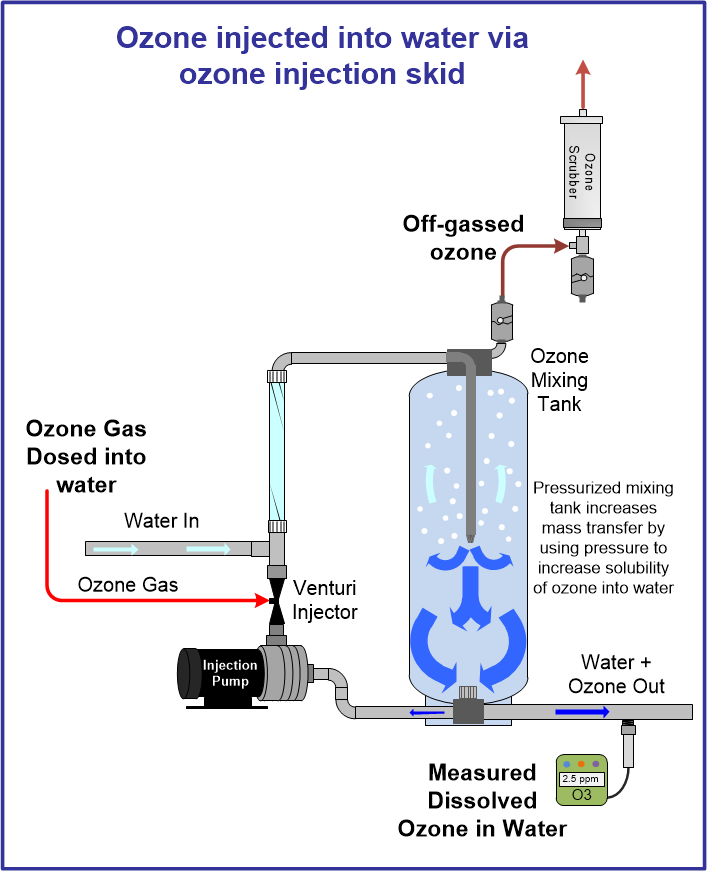
The answer to this question depends on your goal. Some of the primary goals of ozone customers is to kill bacteria in water, break down contaminants, and oxidize iron or other materials through a chemical reaction with the ozone. To achieve this goal, the ozone needs to be dissolved in the water. When ozone is dissolved in water, the ozone is no longer a gas, but at a molecular level it is dispersed evenly throughout the water molecules. The water itself has become an altered compound and reactions often happen very quickly. When dissolve, the level of ozone dissolved in the water can be measured in ppm and it’s disinfection power and oxidation power can be quantified.
When ozone or another gas is in the form of a nano-bubble, the bubble is so small that in many ways it acts like an individual ozone or oxygen molecule, but it is not dissolved in the water, and it’s ability to react with elements or organisms in the water is changed. The gas is locked up in a tiny bubble like a time release capsule. Time is of essence with ozone because it quickly reverts back to oxygen, so if it is locked up too long, it is no longer an ozone bubble, but an oxygen bubble. These tiny oxygen bubbles may be useful for many different applications, but they are not helpful for getting ozone quickly dissolved in water for disinfection or chemical reactions.
The high pressure needed to effectively make nano-bubbles is not a simple matter for ozone. Making ozone is less efficient at high pressures. Ozone leaks become a greater concern at high pressure. The equipment for pressurizing ozone is expensive and the corrosive nature of ozone makes it difficult to maintain. For most of the common applications for ozone, it is not worth the extra work, energy, and new challenges to put the ozone into nano bubbles. There may be applications that make it worth the effort, but it is important to understand your goals for ozone and what is the best method to get there.
We are happy to discuss your goals and share our understanding of ozone to help you reach your goals in the most effective and efficient way possible. Feel free to call us with your ideas. If we don’t know the answer, we will work hard to find an answer.
https://www.oxidationtech.com/ozone/solubility/ozone-dissolved-with-venturi-injector.html
Hi. This is an interesting article, which makes me puzzle a bit. I have developed a pool ozonation system that is based on evenly spread radial flow injectors across the pool, where recirculating water comes after having been added a 10 l/min O2/O3 mix from an O2-fed Corona discharge generator. The O2/O3 mix gets into the water via passive suction using a 2″ venturi pipe, with rated water flow of 30 cubic meters per hour. In general, I can vary the upstream pressure between 1.5 and 2.8 barg, and capacity can range between 15 and 35 cubic meters per hour, as I have the pump driven by a variable frequency drive. In general, the injection loop downstream the venturi would lose no more than 8 meters (0.8 barg) at rated conditions, such that delta pressure across the venturi would not be less than 0.7 to 2.0 barg, depending on the rotation speed of the pump. Now, despite all of the adjustments I can make, I can see massive amounts of large gas bubbles climbing quickly up the 2 meters pool level from the very first injection nozzles. This makes me think that most of the O2/O3 I put in the venturi never turns into small bubbles, it rather gets cohalescence right away and forms large gas blisters in the few seconds it takes the flow to run the 5-10 meters distance between the venturi and the injectors (at around 3.5 m/sec pipe speed). Thus, my conclusion is just that, unless the venturi is totally out of range for my application, for some reason I don’t get, the venturi injector is totally inadequate to actually dissolve ozone into my water. But then you say that nanobubbles would not be a fit either (besides the installed power needs for the mixer), so it looks i am left out of options? What would your suggestion be?
This comes down to a solubility issue. Solubility of gas into a liquid is dependent upon the pressure of the water, concentration of the gas, and temperature of the water. Learn more about solubility here:
https://www.oxidationtech.com/ozone/ozone-basics/fundementals-of-ozone-solubility.html
You did not indicate how well the ozone is dissolving. It is possible that the ozone is dissolving in the water at a very high rate, yet the oxygen is not. This should not be a concern, the goal in your application is to dissolve the ozone, the oxygen is simply the carrier gas.
What would you consider a high pressure for a nanobubbler – you never mentioned that?
A standard oxygen concentrator produces oxygen at 15-20 PSI. We would consider any pressure higher than this to be “high pressure”