
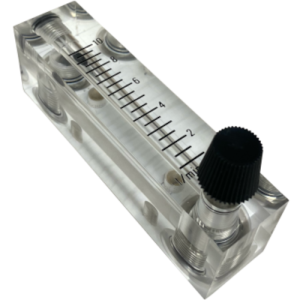
In many oxygen concentrators and ozone generator systems, rotameter-style flow meters (those with a floating ball) are used to visually measure gas flow rates. These devices are reliable, simple, and cost-effective—but only when used under the conditions for which they’re calibrated.
The catch? Most of these flow meters are calibrated to read accurately at atmospheric pressure (0 PSIG). Once the gas is pressurized, your readings become less accurate—often significantly so. If you don’t account for this, you could misdiagnose oxygen purity, miscalculate ozone output, or even cause damage to your system.
Why Accurate Flow Measurement Matters
Accurate gas flow readings are essential for:
- Diagnosing low oxygen purity in oxygen concentrators
- Preventing overloading or damaging oxygen systems
- Calculating ozone production rates in generators accurately
- Verifying gas delivery rates for precision in any application
How Pressure Affects Flow Meter Readings
When pressurized gas (air or oxygen) flows through a standard rotameter, the increased gas density makes the floating ball rise less than it would at atmospheric pressure—even if the actual volumetric flow remains the same. The result? The meter under-reports the flow rate.
Visual Example:
Imagine two identical flow meters:
- The first is at 0 PSI and shows 3 LPM.
- The second is at 20 PSI but with the exact same actual gas flow.
- The pressurized meter might only read 2.2 LPM, even though both flows are identical.
Without correction, this would lead you to underestimate your system’s performance.
Correcting Flow Readings for Pressure
To get an accurate flow measurement under pressure, you must apply a correction factor.
Basic Formula:
Corrected Flow (LPM)=Observed Flow×(P+14.714.7)\text{Corrected Flow (LPM)} = \text{Observed Flow} \times \left(\frac{P + 14.7}{14.7}\right)
Where:
- P = Pressure in PSIG
- 14.7 = Atmospheric pressure in PSI
Example Calculation:
Say your flow meter shows 2.2 LPM at 20 PSIG. The corrected flow is: 2.2×(20+14.714.7)=2.2×2.36=5.2 LPM (approx.)2.2 \times \left(\frac{20 + 14.7}{14.7}\right) = 2.2 \times 2.36 = 5.2 \, \text{LPM (approx.)}
That’s a huge difference!
Tools to Make It Easier
Online Calculator
You don’t have to do the math yourself every time. Use our online flow correction calculator to quickly determine accurate flow rates based on your pressure:
Flow Correction Calculator
Pressure-Flow Charts
Create pre-calculated reference charts using a spreadsheet with expected flow and pressure ranges. This is especially useful in industrial setups where repeated pressure-flow combinations are used.
Why This Matters for Oxidation Technologies Systems
At Oxidation Technologies, we use flow meters that are all calibrated at 0 PSIG (atmospheric pressure). This simplifies correction—since the original calibration pressure is always known.
When used under pressure, these flow meters will still provide reliable measurements—as long as corrections are applied using the chart, calculator, or formula.
Takeaways
- Rotameter flow meters read inaccurately under pressure unless corrected
- Always apply pressure corrections when interpreting readings above 0 PSIG
- Use a formula, calculator, or pre-made chart to determine true flow
- Knowing your exact gas flow ensures optimal system performance and accuracy
You can find more information here: https://www.oxidationtech.com/ozone/ozone-calculations-and-conversions/how-to-correct-flow-reading-for-pressure.html