When evaluating the performance of an ozone generator, two key metrics are commonly referenced: ozone output and ozone concentration. Understanding the difference between these two measurements — and how they apply to your specific ozone application — is crucial for optimizing ozone production and achieving the desired results.
Both metrics are essential for defining the capability of an ozone generator, but their importance varies depending on the intended use. Let’s explore the meaning of ozone output and concentration, how they affect ozone generator performance, and which metric to prioritize for different applications.
Ozone Output vs. Ozone Concentration
Ozone Output
- Measured in: grams per hour (g/hr) or pounds per day (lb/day)
- Definition: Ozone output is the total mass of ozone produced over a given period of time.
- Relationship with Flow Rate:
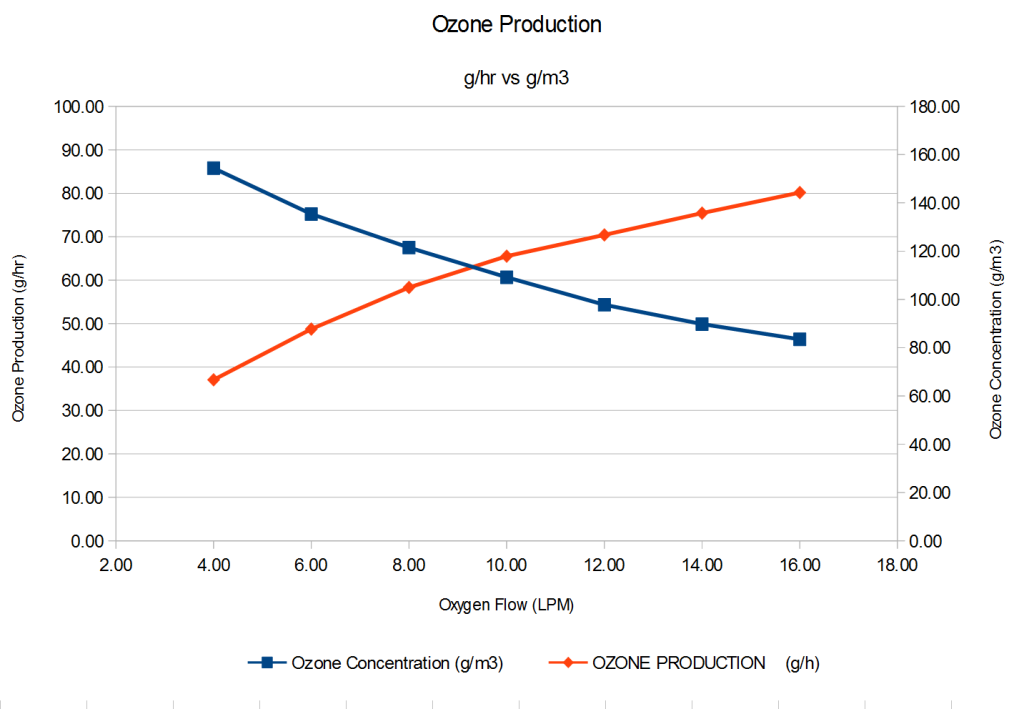
- As the flow rate of feed gas through the ozone generator increases, the total mass of ozone produced increases — but at a lower concentration.
- Higher flow rates result in lower ozone concentration because the contact time for ozone generation decreases.
Example:
An ozone generator producing 100 g/hr at 5% ozone concentration will produce 200 g/hr at 2.5% concentration if the flow rate doubles — but at a lower concentration.
Ozone Concentration
- Measured in: grams per cubic meter (g/m³) or percentage by weight (% wt)
- Definition: Ozone concentration refers to the ratio of total feed gas to the mass of ozone produced.
- Relationship with Flow Rate:
- Lower flow rates increase ozone concentration because the gas spends more time inside the ozone generator.
- Higher flow rates reduce ozone concentration because the gas spends less time in contact with the ozone-generating electrodes.
Example:
If an ozone generator produces 100 g/hr of ozone at 5% ozone concentration, decreasing the flow rate by half could increase the concentration to 10% — but the total mass produced may stay the same or decrease.
Application-Specific Considerations
The relevance of ozone output versus concentration depends heavily on the type of application. Let’s examine how these factors apply to different industries:
1. Water Treatment
In water treatment, ozone concentration is more important than total output.
- Higher ozone concentration improves the solubility of ozone in water.
- Ozone dissolves more efficiently into water at higher concentrations, leading to better oxidation and disinfection.
- If an ozone generator provides the same output at two different concentrations, the higher concentration will result in better overall performance.
Recommendation: For water treatment, prioritize higher ozone concentration over total output.
2. Air Treatment
For air treatment applications like odor removal and food storage, ozone output is more important than concentration.
- Ozone doesn’t need to dissolve — it just needs to be present in sufficient quantity to react with airborne contaminants.
- Higher ozone output means more ozone available to react with odors and pathogens in the air.
Recommendation: For air treatment, prioritize higher ozone output rather than higher concentration.
3. Groundwater Remediation
In groundwater remediation, ozone is often mixed with air to increase the area of influence in the water table.
- Since the ozone is diluted with air, the concentration becomes less important.
- The total mass of ozone introduced into the system matters most.
Recommendation: For groundwater remediation, prioritize higher ozone output.
4. Cooling Towers
Ozone is used in cooling towers as a biocide to control biofilm and bacterial growth.
- Low ozone dosage rates are typically sufficient for cooling tower treatment.
- Since ozone solubility is not critical, the total output of ozone is more important than its concentration.
Recommendation: For cooling tower treatment, prioritize higher ozone output rather than concentration.
Ozone Output vs. Concentration: Finding the Right Balance
In many cases, a balance between ozone output and concentration is ideal. However, as a general rule:
- For water treatment – prioritize ozone concentration.
- For air treatment – prioritize ozone output.
- For groundwater remediation – prioritize ozone output.
- For cooling towers – prioritize ozone output.
If you have the option to choose between two ozone generators with the same output but different concentrations, select the generator with the higher concentration for water-based applications and higher output for air-based applications.
Optimizing Your Ozone System
Choosing the right ozone generator for your application involves understanding the trade-offs between output and concentration. If you need help selecting the best ozone generator for your specific needs, contact us today. Our experts will guide you toward the ideal solution for your system, ensuring maximum efficiency and performance.
You can find this product here: https://www.oxidationtech.com/ozone/ozone-system-design/solubility.html