Ozone Applications

HMOS Ozone Sensors Explained
Heated Metal Oxide (HMOS) Ozone Sensors – How It Works and When to Use them
Heated Metal Oxide Sensor (HMOS) technology is a rugged, long-life method for ozone detection commonly used in industrial safety, equipment interlocks, and low-ozone environments. These sensors are known for their durability, fast response, and ability to operate in harsh environmental conditions where other sensor types may struggle.
How Heated Metal Oxide Ozone Sensors Work
HMOS sensors detect ozone based on changes in the electrical resistance of a heated semiconductor metal oxide surface when it interacts with ozone and other oxidizing gases.
Core Principle
A tiny ceramic bead or planar sensor element—typically coated with tin dioxide (SnO₂) or a similar metal oxide—is electrically heated to a controlled high temperature. When ozone molecules come into contact with this hot surface, they react with oxygen species on the sensor, causing a change in electrical resistance.
That resistance change is measured as a voltage change and converted into an ozone concentration reading in ppm.
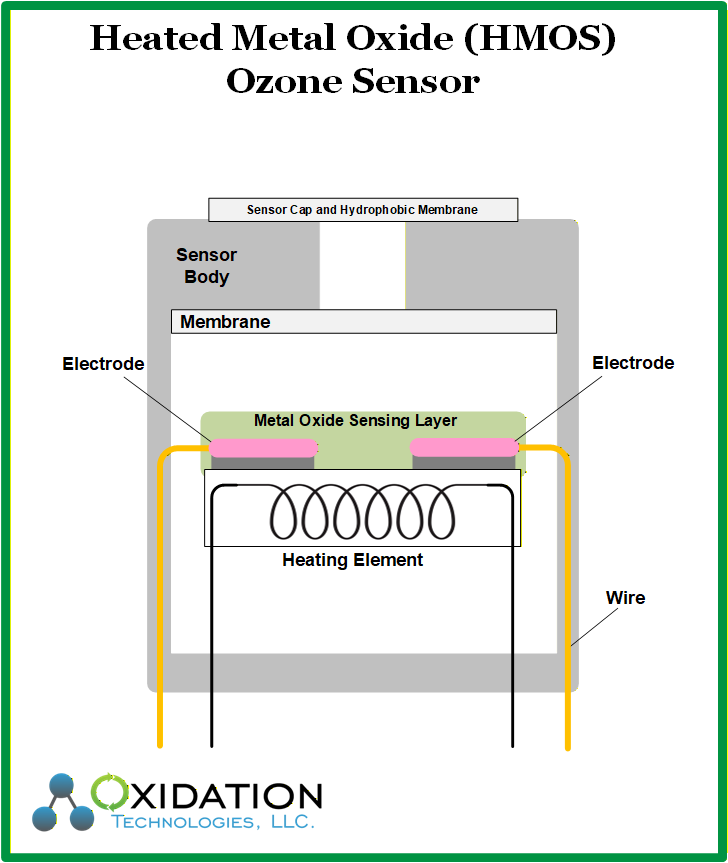
Operating Mechanism of Electrochemical Ozone Sensors
- Integrated Micro-Heater
- Heats the metal oxide element to its operating temperature (typically 200–400°C).
- Metal Oxide Sensing Layer
- Exposed directly to the ambient air or sampled gas stream.
- Ozone Interaction
- Ozone, being a strong oxidizer, reacts on the sensor surface and alters the charge carrier density.
- Resistance Change Measured
- The electronics detect the change in resistance and translate it into a concentration signal.
Advantages of Heated Metal Oxide Ozone Sensors
- Extremely rugged sensor design
- Very fast response time (often <10 seconds)
- Long service life – No electrolyte to be consumed, no moving parts
- Low-range sensitivity – Responds to ozone at ppb ozone levels
- Operates in wide temperature and humidity ranges – Due to the heater, operates in wider temperature and humidity range
Limitations of Heated Metal Oxide Ozone Sensors
- Higher power consumption due to the heater
- Higher Cross-sensitivity responses - High response to VOC’s, and many other competing gasses
- Warm-up period required – Sensor takes time to achieve operating temperature and stable ozone readings.
For applications where durability and operating in harsher environments matter more than ultra-precise selectivity to ozone, HMOS is often the preferred choice.
Where Heated Metal Oxide Ozone Sensors Are Used
HMOS sensors are best suited for ambient ozone measurements for human safety in long-term operation where competing gasses may be minimal.
Ozone Generator Safety Interlocks
- Automatic shutdown systems
- Over-ozone alarm triggers
- Backup safety monitoring for high-output generators
HMOS sensors are often used as hardwired interlock devices to protect personnel and equipment.
Fixed-mount Human Safety Sensors
- Human safety detection ensuring safe environments for workers
- Ozone equipment rooms
- Laboratories where ozone is used
Long-term, accurate ozone measurement where ozone low-level ozone detection is required, HMOS sensors excel.
Low-level Ozone Detection on a Budget
- PPB level ozone detection
- Much lower cost sensors than UV Absorption
- Lower cost calibration costs than UV Absorption long-term
Great option for low-cost ozone measurement in ppb ranged, excellent for environments where low level ozone measurement is required with a lower budget than UV Absorption.
Electrochemical sensors are ideal anywhere low-level ozone monitoring is needed for safety, compliance, or portable detection.
Why Choose a Heated Metal Oxide Ozone Sensor
Choose Heated Metal Oxide sensing when your application requires:
- Rugged, long-life ozone detection
- Low-level ozone detection (ppb levels)
- Fast alarms in industrial environments
- Resistance to humidity, dust, and temperature extremes
- Lower long-term ownership cost from extended sensor life
HMOS sensors are the workhorse solution for industrial ozone safety, especially in generator rooms, treatment chambers, and facilities where ozone may be present at elevated levels.
Ozone Monitor Information:
|
Ozone Sensor Technologies Compared
|
|
|
|
We offer additional gas detection products in partnership with our subsidiary, Gas Sensing. For gasses other than ozone view the Gas Sensing website. |
|
|
|