Ozone Applications

UV Ozone Analyzers Explained
UV Absorption Ozone Analyzer – How It Works and When to Use It
How UV Absorption Ozone Analyzers Work
UV absorption is considered the gold standard for ozone measurement due to its accuracy, stability, and long-term reliability. UV based Ozone analyzers operate based on the principle that ozone molecules absorb ultraviolet (UV) light at the specific wavelength of 254 nm.
View our list of UV Absorption Analyzers HERE
Core Principle
Ozone strongly absorbs UV light at 254 nm. By shining UV light through a sample cell and measuring how much of that light is absorbed, the analyzer can calculate the exact ozone concentration using the Beer–Lambert Law.
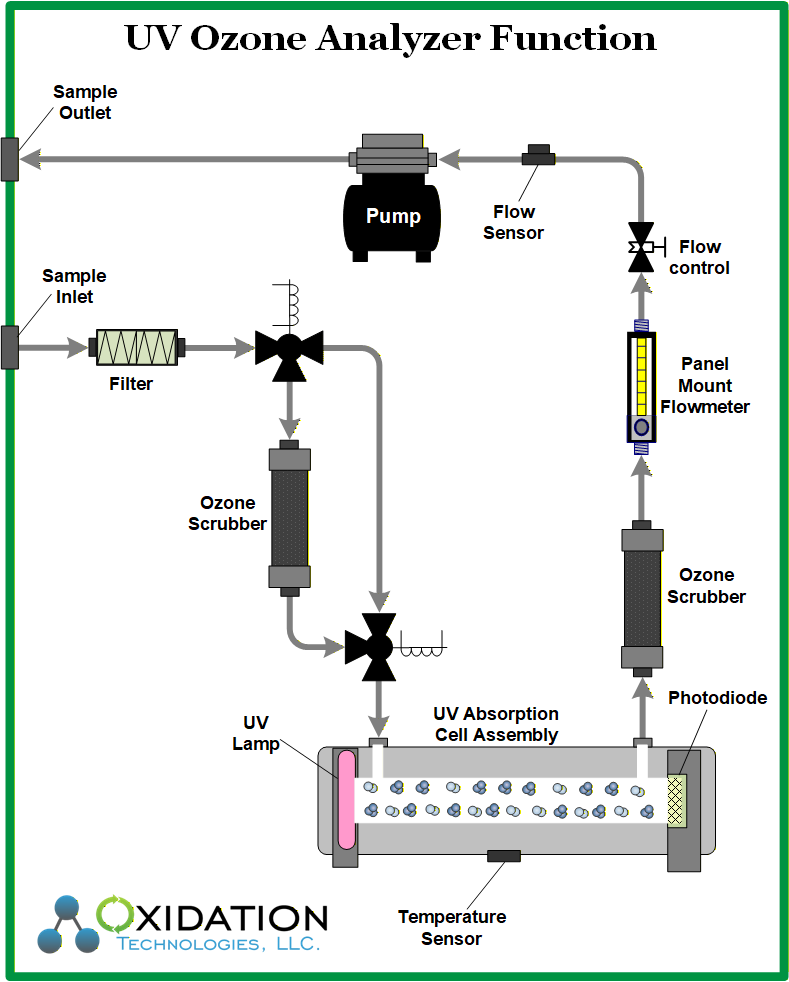
Operating Mechanism of UV Ozone Analyzers
A UV ozone analyzer typically includes:
- UV Light Source
- Usually, a low-pressure mercury lamp producing stable UV light at 254 nm.
- Sample Cell (Optical Pathway)
- Sample gas is drawn through this chamber, and the UV light passes through it.
- Detector
- Measures the intensity of UV light after it passes through the sample.
- Reference Measurement
- A second optical path or filtered air stream provides a “zero ozone” reference.
- Signal Processing
- The analyzer computes ozone concentration based on the reduction in UV intensity caused by ozone absorption.
Because the relationship between ozone concentration and UV absorption is linear and well-defined, UV analyzers provide highly repeatable, stable ozone measurements over long periods.
Advantages of UV Ozone Analyzers
- Highly accurate ozone measurement
- Provides much more accurate measurement than sensor based technologies, up to 1% accuracy is possible
- Unaffected by other oxidizing gases (Minimal cross sensitivity)
- UV absorption is highly selective, other oxidizing gasses that would cause cross sensitivity issues with sensor based technologies will not cause interference with the UV Analyzer
- Humidity, temperature, and pressure changes can be compensated for accurately
- Minimal drift over time, stable reading long-term
- As there are no consumables and the reading is checked against zero gas during operation the ozone readings will remain much more stable than sensor based technologies
- Long service life with low maintenance
- The UV lamp has a much longer life than consumable sensor cells
- Minimal service is required long-term, calibrations can be performed on-site
- Linear response, broad measurement range
- UV absorption allows for linear measurement of ozone across a much broader measurement range than is possible for sensor based technologies
- Measures ozone at high concentrations
- Ozone gas does not come into contact with consumable components. Therefore, high ozone concentrations can be measured
- Linear response allows for ozone concentration readings as high as 25% by weight or 500 g/m3
- Ideal for continuous monitoring and data logging
- Due to minimal drift of readings the UV analyzer can measure ozone in air long-term reliably without maintenance, calibration, or service.
UV absorption is the method required by many regulatory bodies, including the U.S. EPA, for ambient ozone monitoring.
View our list of UV Absorption Analyzers HERE
Where UV Absorption Ozone Analyzers Are Used
UV absorption ozone analyzers are ideal for applications requiring precision, long-term stability, and regulatory-level accuracy. They are best suited for:
- Ozone Generator output measurement
- Ozone generator output verification – high concentration ozone analyzers
- Process control loops
- High-concentration ozone feed gas measurement
- Ozone system performance validation
These analyzers can be used to measure the output of an ozone generator or
- Environmental and Ambient Air Monitoring
- Outdoor ozone measurement for air-quality compliance
- Indoor air monitoring in facilities using ozone
- Fixed safety monitoring in ozone workspaces
Because UV absorption is free from cross-sensitivity, it's the preferred method for accurate ambient ozone readings.
- Laboratory and Research Settings
- Analytical ozone measurement
- Calibration of other ozone sensors
- Precision experiments requiring stable ozone levels
Researchers value UV analyzers for their reproducibility and low drift, overall accuracy.
- Ozone Destruct and Off-Gas Monitoring
- Verifying ozone destruct efficiency
- Monitoring residual ozone in off-gas streams
- Ensuring compliance before venting to atmosphere
UV analyzers provide near-instant, reliable readings even at low residual ozone concentrations without risk of damaging a sensor in the event of higher ozone concentrations.
- Process control in critical environments
- Control ozone in food storage environments
- Control low ozone levels in environments where humans will be present
- High-value processes where precise ozone levels are required
- Ozone measurement in harsh environmental conditions
- High temperature applications, analyzer is temperature compensated
- High humidity applications, process gas can be dried prior to the analyzer
- High dust environments, filters are available to filter the sample gas
Why Choose a UV Absorption Ozone Analyzer
Use a UV absorption analyzer when your application demands:
- High ozone level measurements (% by weight range)
- Low ozone level measurements (ppb range)
- Regulatory-grade accuracy
- Long-term measurement stability
- No interference from other gases
- Low maintenance and dependable operation
- Reliable data logging and trending
If you need precise, trustworthy ozone measurements—especially for process control or regulatory reporting—UV absorption is the best technology available.
View our list of UV Absorption Analyzers HERE
Ozone Monitor Information:
|
Ozone Sensor Technologies Compared
|
|
|
|
|
|
We offer additional gas detection products in partnership with our subsidiary, Gas Sensing. For gasses other than ozone view the Gas Sensing website. |
|