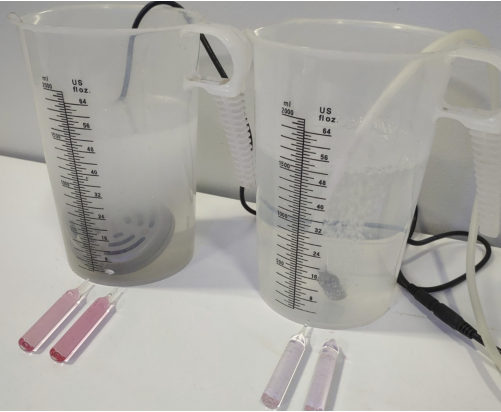
Below are the results of an experiment demonstrating two simple and inexpensive ways to get ozone dissolved into water. On the left is an O-Pod 10 in a liter of water. You can see a cloud of tiny ozone bubbles coming from the puck. On the right is a bubble diffuser hooked to an Enaly OZX-300. You can see the bubbles rising to the surface. The pod uses about 14 watts of power and the OZX-300 uses about 7 watts. Every two minutes I took a sample of water and measured the dissolved ozone levels using the I-2019 dissolved ozone test kit. https://www.oxidationtech.com/products/ozone-monitors/dissolved-meters/i-2019.html. The darker pink vacuviols indicate more dissolved ozone.
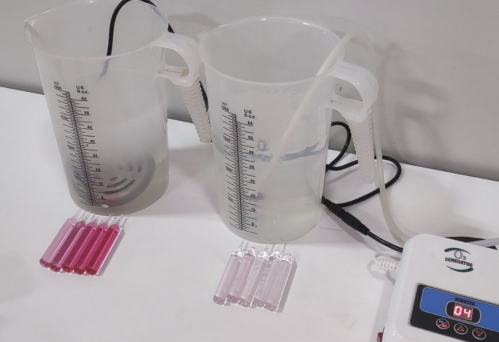
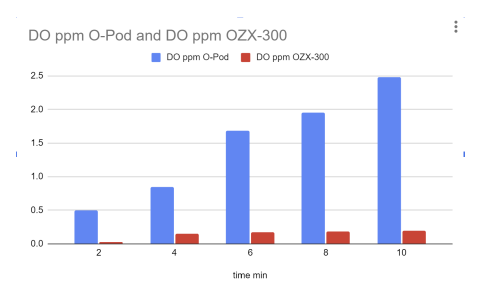
After taking 5 samples, it was clear that the O-Pod was much more effective at getting ozone into the water.
The measurements of dissolved ozone from this experiment are displayed in the graph below.
Ozone is a gas. Water is a liquid. If I try to put some ozone into water, it just floats to the top. A diffuser will make really small bubbles that float more slowly to the top. A nano-bubbler will make bubbles so small they act like water molecules and don’t float to the top. But what we really want is to get the ozone dissolved in the water so that it fits right into empty spaces between water molecules and behaves in a predictable way to react with things in the water and destroy pathogens on a molecular level.
The simplest, smallest, and most cost effective way that I know of to get a small batch of ozone dissolved in water is an electrolytic ozone generator. Ozo-Pod – electrolytic type ozone generator that is immersed in water and makes ozone directly in the water. It does a great job of bringing ozone levels up to the point where pathogens are killed, and there is no concern of excess ozone gas and breathing concerns. https://www.oxidationtech.com/ozo-pod.html This could be immersed in the water tank and run continuously or periodically with a timer. Calcium in the water forms a crust that needs to be removed periodically with a solution of vinegar water.
Buildup of deposits on the electrolytic elements is the main disadvantage of this type of ozone water generator, but this particular product is robust and able to be revived with vinegar water without degrading the elements. If you are willing to invest some time and effort into cleaning, this is a very simple way to get a concentration of a few parts per million (ppm) ozone dissovled in water.
The Ozo-Pod 10 is a medium sized electrolytic ozone generator. The Ozo-Pen is much smaller https://www.oxidationtech.com/o-pen.html and the Ozo-Pod 50 and 1000 are larger. We also are developing a continuous flow system that will use this electrolytic generator to deliver ozone water on tap.
Another low cost method for getting ozone into water is to use a gas ozone generator with a fine bubble diffuser. The OZX-300 comes with a small air pump, air dryer, and fine bubble diffuser to make this happen. https://www.oxidationtech.com/ozx-300.html. As noted at the introduction, the little ozone bubbles float to the top and much of it is wasted, but not all. Some of it gets dissoved in the water in accordance with Henry’s law. It may be enough to help disinfect a bowl of fruit, and this method is used on a large scale to provide disinfection for water treatment plants. Still, much of the ozone is wasted and needs to be safely disposed of. (See “Electrolytic Ozone Generators” link)
According to Henry’s law, you can get more ozone to dissolve in the water when the water is under pressure, is cold, and the ozone concentration is high. You can study our resources at the following link to get more details. https://www.oxidationtech.com/ozone/solubility.html The equipment needed to fulfill the conditions for better ozone solubility quickly adds more expense and bulk to an ozone water injection system.
Our injection skids are engineered to provide the high ozone concentrations, water pressure and flow dynamics that maximize ozone solubility. We provide a wide range of customizable skids to suit the customer’s needs. When a continuous flow of ozonated water at specific flows and ozone concentration is needed, a well designed ozone injection skid will dissolve 90% of the ozone into the water.
Injection loop – If higher water flows and higher concentrations of ozone are needed, the best way is an injection skid. https://www.oxidationtech.com/products/ozone-water-system.html The simplest model we have is the WT-4 which uses the energy from your well pump to inject ozone into the water of your home while the pressure tank is filled. https://www.oxidationtech.com/products/ozone-water-system/wt-4-ozone-water-system.html
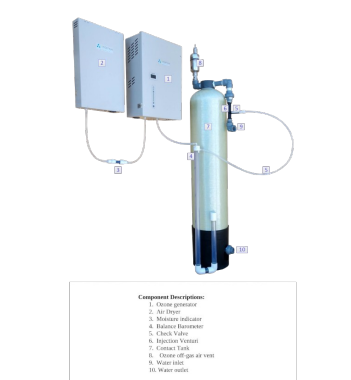
The WT-1 uses its own injection pump instead of the well pump to inject ozone into the water.
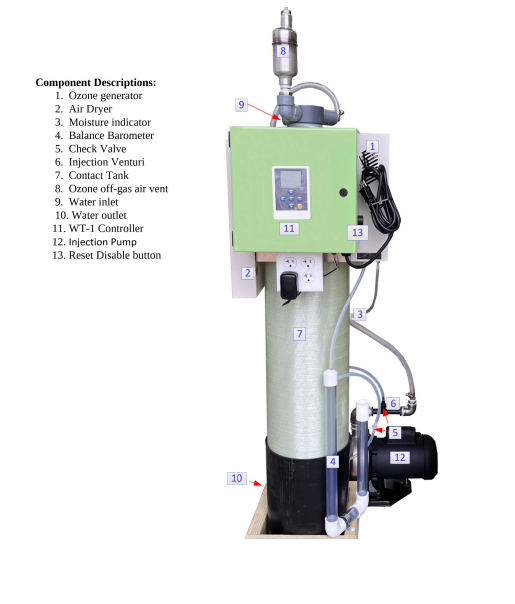
We provide industrial ozone injection skids ranging from injecting 4 grams per hour of ozone to 1000 grams per hour or more. https://www.oxidationtech.com/products/ozone-water-system.html
The OZX-300 performs poorly dissolving ozone into water because the ozone concentration produced by the generator is very low, and the water pressure is very low. Electrolytic ozone generators perform well because the ozone is formed directly from the water. This method, however faces stiffer competition when an industrial ozone generator is fed with oxygen and the high concentration ozone is injected into water under pressure. Under these conditions, large quantities of dissolved ozone can be made much more efficiently that with electrolytic ozone generators.
Dissolving ozone gas into water with gas ozone generators, pumps, and oxygen concentrators has found a home in large water treatment facilities. Large bulky equipment is not a problem because everything about these facilities is large. Over time reliable ozone generators and small oxygen concentrators have helped move this technology into a wide variety smaller industrial applications and even individual home water treatment systems. In contrast, electrolytic ozone generators have gained traction in small applications for travelers or campers in need of clean water. As the technology develops, electrolytic generators are growing into larger applications. We are constantly exploring and evaluating the new technology to determine what is best for a variety of applications.