Food safety and shelf life are critical concerns in beef (red meat) processing. The use of ozone—in either aqueous or gaseous form—offers processors an effective and chemical-free antimicrobial solution. Ozone has been proven to inactivate Escherichia coli, Listeria monocytogenes, and other common foodborne pathogens responsible for illness and spoilage.
With decades of research and successful applications in the food industry, ozone has become a trusted intervention technology for ensuring both product safety and quality.
Why Use Ozone in Red Meat Processing?
Ozone is the most powerful oxidizer available for food processing and offers several unique benefits:
- Excellent antimicrobial ability – bacteria cannot develop resistance to ozone
- No chemical residuals – ozone reverts safely to oxygen after use
- No chemical storage – ozone is generated on-site, reducing handling risks
- Lower operating costs – only electricity is required for ozone generation
- Synergy with other interventions – enhances the effectiveness of HACCP systems
- Improved air quality – ozone reduces airborne pathogens and odors
Regulatory Approvals
- GRAS Status: The FDA and USDA have granted ozone Generally Recognized as Safe (GRAS) approval for use in food processing. This allows ozone to be applied at appropriate levels with no regulatory limit, provided good manufacturing practices are followed.
- Organic Approval: The National Organic Program (NOP) permits ozone use for red meat processing. It can be applied directly to the meat as a sanitizer while maintaining organic certification.
Aqueous Ozone Applications
Aqueous ozone (ozonated water) is widely used in beef processing because it is versatile, safe, and effective. Since ozone has a short half-life, it must be generated and applied on-site.
Ozone Levels in Water
- Effective treatment requires ≥ 2.0 ppm dissolved ozone in water.
- 2.0–5.0 ppm is recommended for most red meat applications, balancing antimicrobial efficacy and worker safety.
- Water pressure of 10–30 PSI works best, avoiding misting sprays that can cause ozone off-gassing.
Application Methods
- Carcass sprays – Ozonated water is applied directly in carcass washes or chillers.
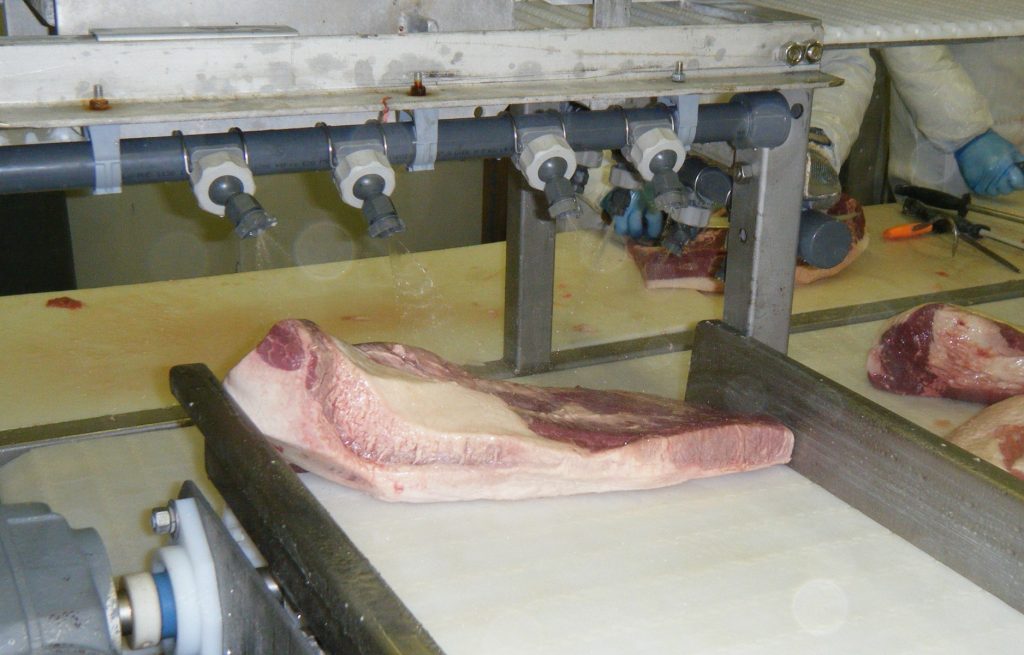
- Trim sprays – Multiple nozzles ensure full coverage as meat passes on conveyors.
- Equipment sanitation – Knives, conveyors, and machinery can be rinsed with aqueous ozone.
Proper nozzle design and contact time (at least 1–3 seconds) are critical for maximum effectiveness.
Gaseous Ozone Applications
Ozone gas can be applied directly in controlled environments such as storage rooms, chillers, or ozone tunnels.
- Low levels of gaseous ozone help extend shelf life by suppressing bacterial growth.
- Higher levels (not safe for human exposure) can be used in closed systems to reduce microbial counts significantly.
- Applications require careful engineering to balance microbial reduction, meat quality, and worker safety.
Gaseous ozone also provides benefits that aqueous ozone cannot—such as sanitizing surfaces in hard-to-reach areas, controlling odors, and reducing airborne cross-contamination.
Ground Beef Applications
Ozone is also effective in ground beef processing:
- Ozone Gas in Mixers – Low levels of ozone gas introduced during mixing reduce bacterial loads.
- High-Level Ozonated Water – Dissolved ozone water can be added during processing to restore product weight (“shrink”) while providing antimicrobial action.
Both approaches require careful monitoring to ensure consistent microbial control without negatively impacting product quality.
Conclusion
Ozone is a safe, effective, and sustainable antimicrobial intervention for beef (red meat) processing. Whether applied in aqueous or gaseous form, ozone reduces pathogens, extends shelf life, improves facility hygiene, and lowers chemical handling risks.
With FDA/USDA GRAS status and approval for organic processing, ozone offers processors a flexible solution that aligns with food safety goals and consumer demand for cleaner, chemical-free food production.
You can find more information here: https://www.oxidationtech.com/applications/agri-food/beef-red-meat-processing-with-ozone.html