Technical Summary with Supporting Literature
Iron (Fe) and manganese (Mn) are common groundwater and surface-water contaminants that affect color, turbidity, taste, staining, and overall water quality. Traditionally, utilities rely on oxidants like chlorine or potassium permanganate to convert dissolved metals into filterable solids. However, extensive research shows that ozone (O₃) is a highly effective, versatile, and economical alternative oxidant for Fe/Mn removal.
This document provides a concise overview of why ozone is an excellent choice for iron and manganese treatment, supported by four scientific and engineering papers you provided.
Ozone Rapidly Oxidizes Iron and Improves Filtration
The study “Iron Behavior in the Ozonation and Filtration of Groundwater” demonstrates that ozone converts dissolved ferrous iron (Fe²⁺) into ferric iron (Fe³⁺) very quickly, forming dense, easily filterable precipitates.
Key findings include:
- Faster oxidation than conventional oxidants
- Formation of larger, more stable ferric flocs
- Improved filter performance and longer filter runs
This makes ozone ideal for both municipal and industrial systems where filtration efficiency and operating cost are priorities.
Reference: “Iron Behavior in the Ozonation and Filtration of Groundwater”
Ozone Effectively Oxidizes Manganese—even in Challenging Waters
Manganese is often harder to oxidize than iron, especially at typical drinking-water pH levels. The paper “Oxidation of Iron and Manganese by Ozone” confirms that ozone is highly effective at oxidizing dissolved Mn²⁺ to manganese dioxide (MnO₂):
- Ozone initiates Mn oxidation quickly
- MnO₂ formed during ozonation can be removed through standard granular media filters
- Ozone performs well even in water with challenging chemical conditions
For treatment plants that struggle to meet manganese limits using chlorine, aeration, or permanganate, ozone provides a more robust oxidation pathway.
Reference: “Oxidation of Iron and Manganese by Ozone”
Ozone Works Even When Iron and Manganese Are Complexed With Natural Organics
Natural organic matter (NOM)—humic and fulvic acids—can bind or “complex” iron and manganese, making them difficult to oxidize. The study “Iron and Manganese Removal with Ozonation in the Presence of Humic Substances” is especially important.
It shows that:
- Ozone successfully oxidizes Fe and Mn even in the presence of humic substances
- Ozone breaks down these organic coatings and frees metals for oxidation
- The process simultaneously improves color and reduces organic load
This is a major advantage over oxidants like chlorine or potassium permanganate, which often struggle with metal–organic complexes.
Reference: “Iron and Manganese Removal with Ozonation in the Presence of Humic Substances”
Ozone Outperforms Other Oxidants for Complexed or “Hard-to-Treat” Iron
In the study “Which Is the Best Oxidant for Complexed Iron Removal from Groundwater – The Kogalym Case,” different oxidants—including ozone and potassium permanganate—were tested on groundwater containing organically complexed iron.
The results showed:
- Ozone provided more complete oxidation
- Ozone broke down strong metal–organic complexes more effectively
- Ozone produced solids that filtered out more easily
This makes ozone an excellent option for difficult waters where iron or manganese has resisted oxidation using more traditional approaches.
Reference: “Which Is the Best Oxidant for Complexed Iron Removal from Groundwater: The Kogalym Case”
Additional Benefits of Ozone for Metal Removal
- Simultaneous color and turbidity reduction
- Ozone oxidizes organics responsible for color and reduces colloidal turbidity.
- Improved filter performance
- Research shows ozone-generated precipitates form better filterable solids, resulting in longer filter runs and reduced backwashing needs.
- Broad-spectrum oxidation
- Ozone can also oxidize organics, sulfides, taste-and-odor compounds, and some emerging contaminants.
- No chemical residuals
- Unlike permanganate or chlorine, ozone decomposes back to oxygen, avoiding chemical byproducts or residual color.
- Flexible integration
- Ozone can be applied via sidestream injection, contact basins, or integrated ozone-filtered systems depending on plant layout.
Typical Ozone Treatment Configuration
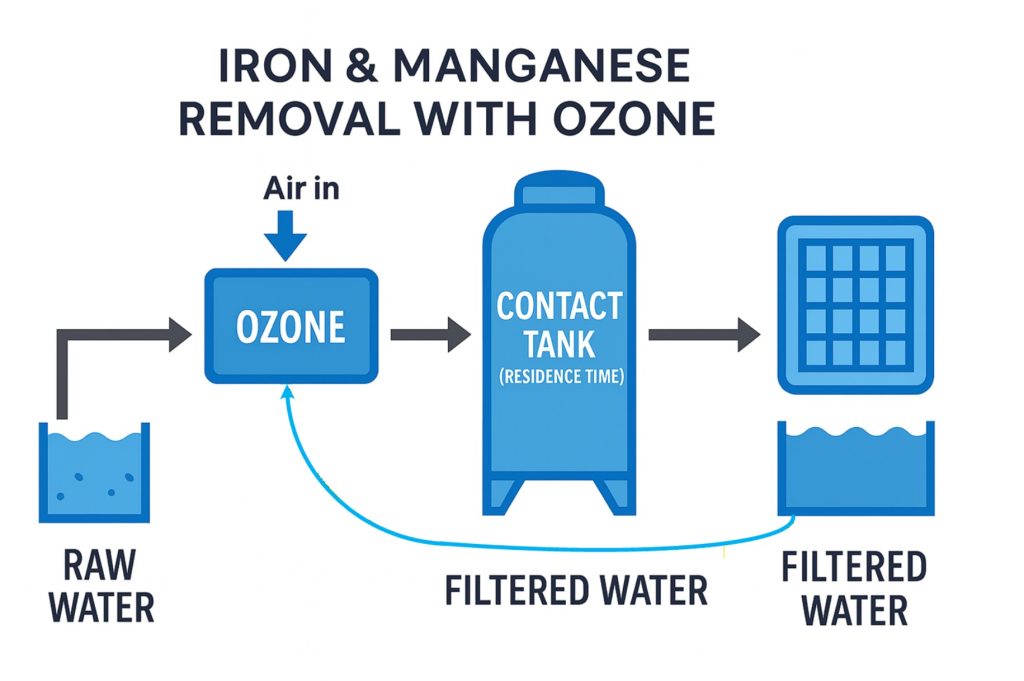
A generalized ozone-based process for Fe/Mn removal includes:
- Ozone injection (direct or sidestream)
- Static mixer or pipeline contactor
- Contact tank for metal oxidation and solids formation
- Granular media filtration (sand, dual-media, GAC, or catalytic MnOx media)
- Backwash and solids removal system
This configuration applies broadly to drinking water plants, industrial process water systems, and decentralized treatment units.
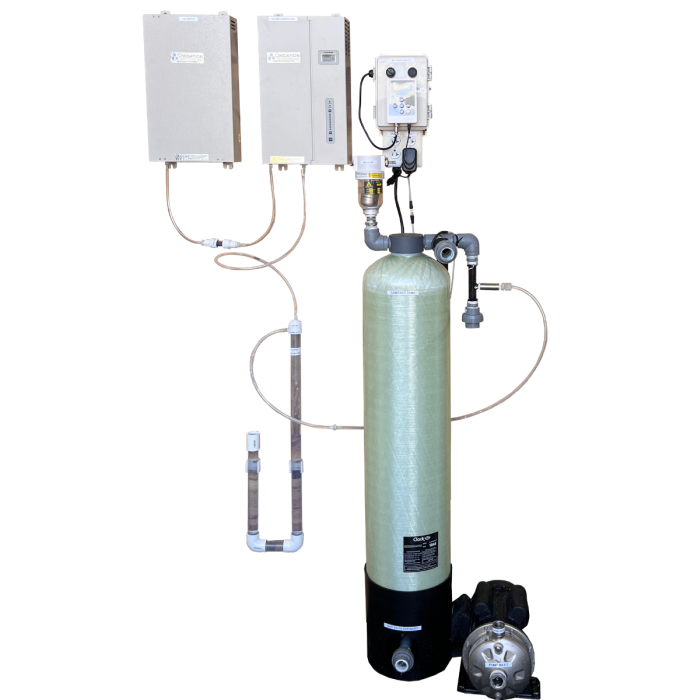
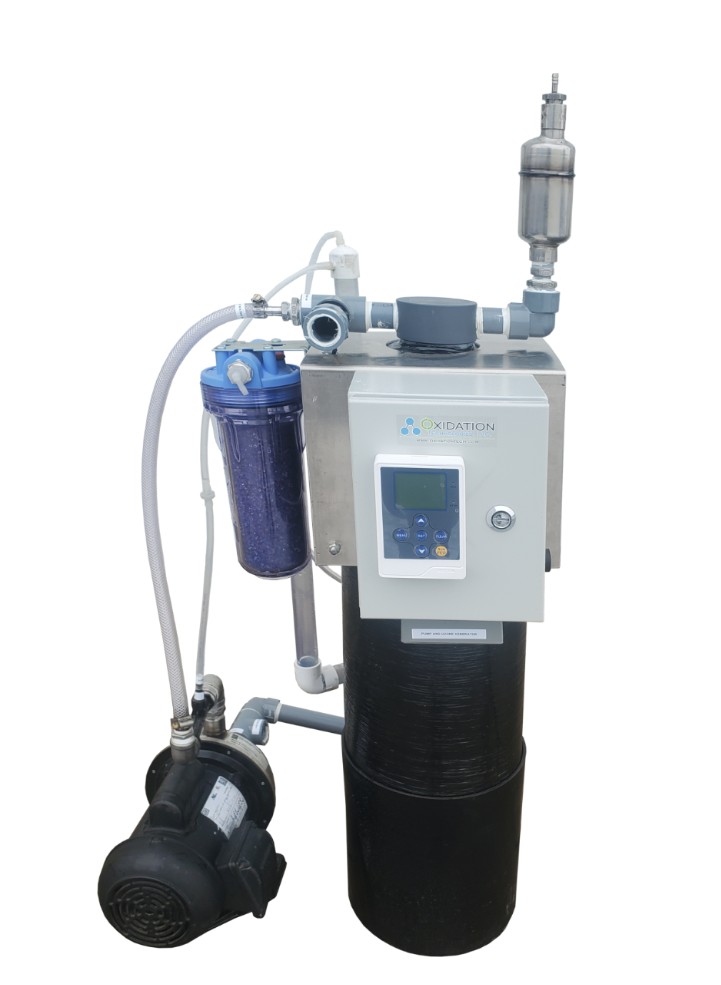
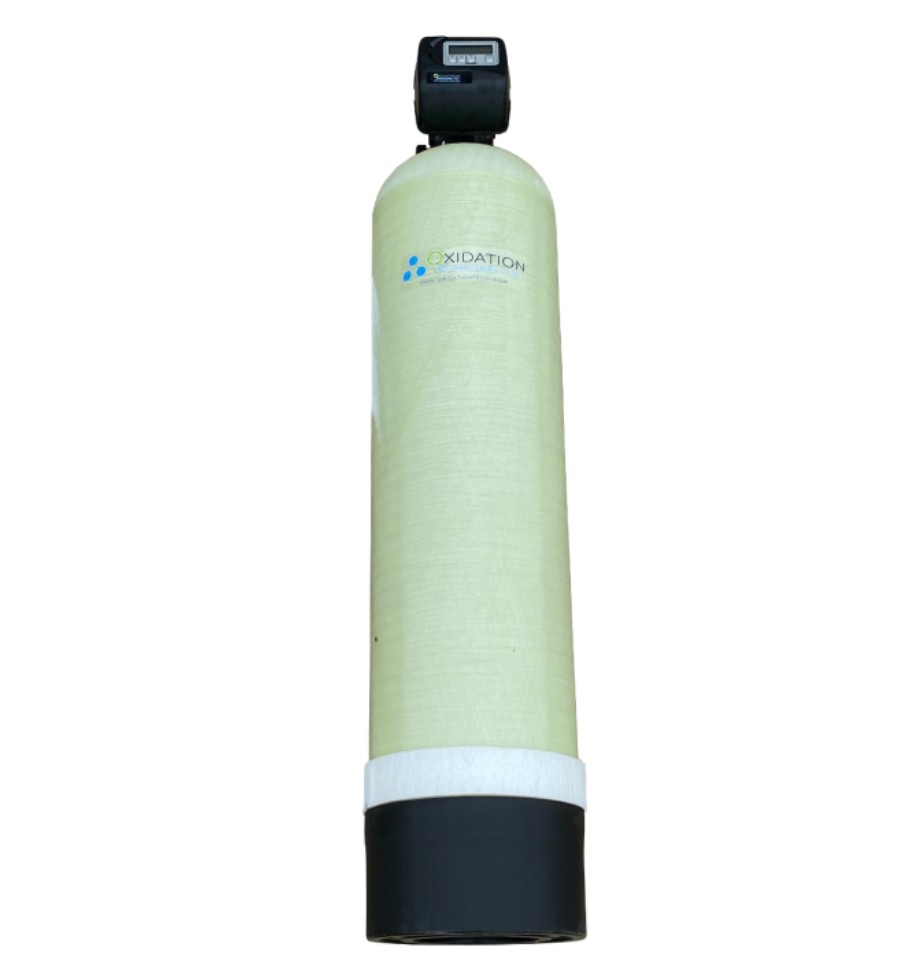
Application: Oxidation Tech Products
Conclusion
Across all four referenced documents, ozone is shown to be:
- Highly effective for oxidizing both iron and manganese
- Superior in waters containing natural organic matter or complexed metals
- Beneficial for filtration and overall plant performance
- An environmentally friendly, multi-benefit oxidation technology
For any utility or industry seeking a reliable, single-step oxidant to improve metal removal, ozone is a proven, well-documented, and technically sound solution.