
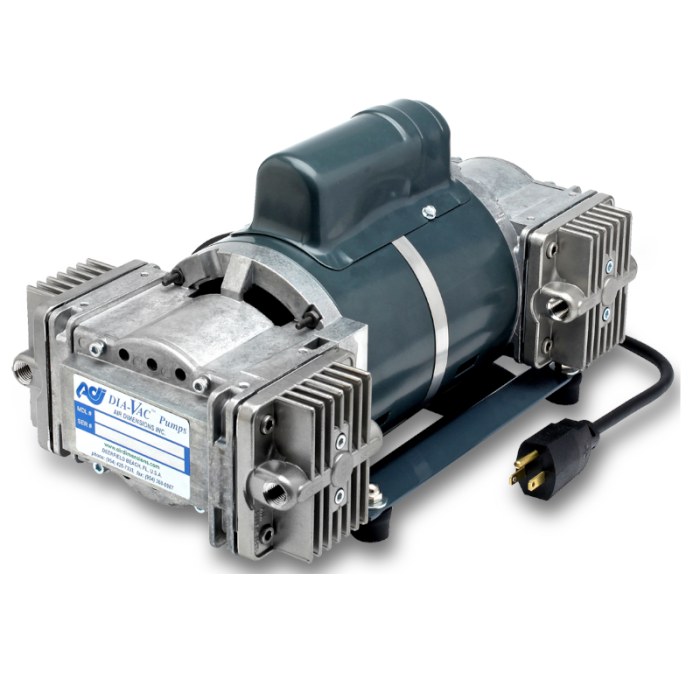
Ozone systems often require gas to be pressurized for specific applications—whether to inject ozone into water lines, fill tanks, or deliver ozone to high-pressure environments like force-mains in wastewater treatment. The Quad Head OC-7 Pump is designed specifically for these demanding scenarios, offering durable construction, reliable performance, and ozone-resistant materials to ensure safe and effective operation.
Engineered for Ozone Applications
The OC-Series compressors, including the OC-7, are uniquely suited for ozone-related use. With either Aluminum or 316 Stainless Steel heads and 3-ply Teflon diaphragms, the wetted materials are fully resistant to the corrosive nature of ozone gas at any concentration. Whether you’re working with air-fed or oxygen-fed ozone generators, the OC-7 is built to last.
Key Specifications:
- Capacity: Eccentric – 0.222
- Wetted Materials:
- Head: Aluminum or 316 Stainless Steel
- Diaphragm: 3-Ply Teflon
- Motor:
- Type: TEFC (Totally Enclosed Fan Cooled)
- Power: 1/2 HP
- Voltage: 115V
- Frequency/Phase: 60 Hz, 1 Ph
Important Considerations for Ozone Compression
1. Heat and Ozone Stability
Compression generates heat—and heat destroys ozone. As ozone is compressed, the resulting heat can reduce ozone concentration. When designing a system that includes compression, consider increasing your ozone production to compensate for any loss during the pressurization process.
2. Pressure and Vacuum Load
If your application involves both vacuum and pressure, be sure to factor both forces into your compressor selection. The OC-Series compressors are capable of handling these dynamic loads, but proper sizing is crucial.
3. Material Selection
- Stainless Steel heads are ideal for air-fed ozone generators due to better corrosion resistance.
- Aluminum heads, while not recommended for air-fed ozone systems, dissipate heat better, which helps preserve ozone concentration during pressurization and are suitable for oxygen-fed systems.
4. Restart Capabilities
These compressors can re-start under pressure, but with limitations. For applications where pressure build-up is frequent, please contact us for guidance on system design and compressor performance.
Common OC-7 Applications
- Pulling ozone from a vacuum-driven generator and air dryer
- Boosting ozone pressure for lab or pilot-scale testing
- Filling ozone contact tanks or small vessels
- Injecting ozone gas into pressurized water lines when a venturi isn’t viable
- Pushing ozone into force-mains in wastewater treatment systems
System Examples
1. Vacuum-Driven Ozone Generator with Compressor Boost
Using a vacuum-driven air dryer, ozone is efficiently produced from dry air. The OC-7 Pump then pulls this ozone and pushes it to the point of use. This configuration is:
- Cost-effective
- Scalable
- Ideal for small-to-medium ozone injection systems
2. Ozone for Wastewater Force-Mains
Wastewater lift stations often have pressurized force-mains where ozone is injected to control odors and reduce corrosion from hydrogen sulfide (H₂S). These systems often operate at pressures above 50 PSI, requiring the use of a boost compressor like the OC-7. By increasing ozone pressure above line pressure, ozone can be effectively delivered into the force-main without chemical injection pumps.
Conclusion
The Quad Head OC-7 Pump is a vital tool for safely and effectively pressurizing ozone gas in a wide variety of industrial and environmental applications. With ozone-compatible materials, robust motor power, and thoughtful design, it offers a flexible and durable solution for systems that require both vacuum and pressure capabilities.
You can find this product here: https://www.oxidationtech.com/oc-7.html