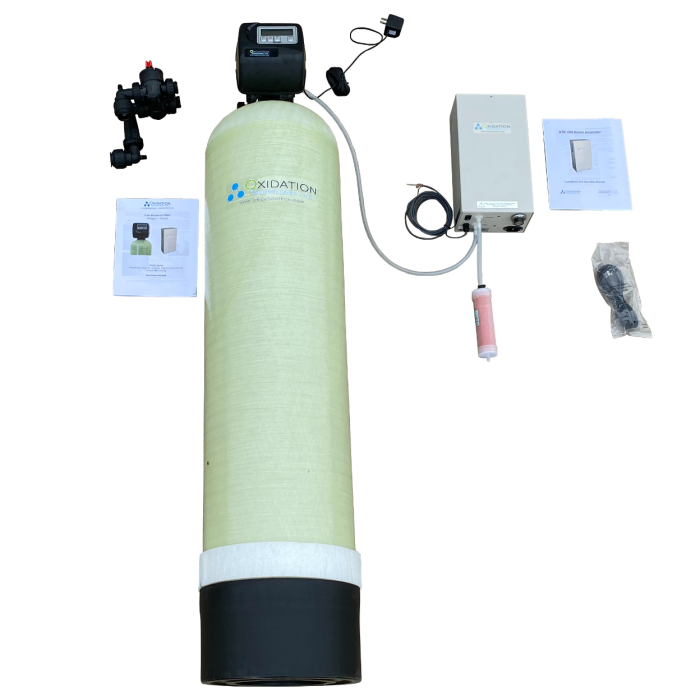
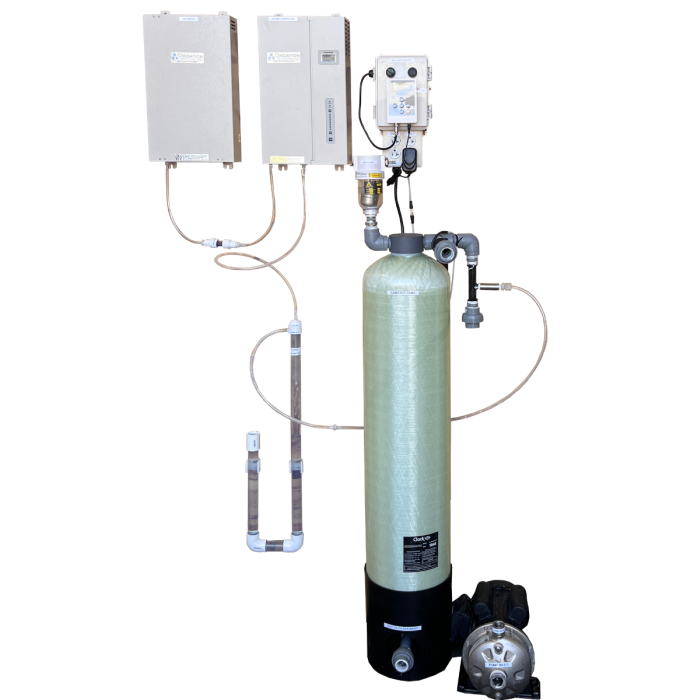
This “Ozone for Iron, Manganese, and Bacteria in Domestic Well Water” case study provides performance data for our WT-4 ozone water treatment system installed at a customer’s home. Ozone does a great job oxidizing dissolved iron and manganese in well water so that it can be effectively filtered and removed from the water. The ozone also serves to destroy iron bacteria which thrive in even very low levels of dissolved iron and form biofilms that clog filters and plumbing fixtures. Our WT ozone water treatment package is an industrial quality system designed to dose well water with ozone, and work with a back-washable filter to solve iron, manganese, bacteria, and odor problems. This customer installed the system and has provided the following case study:
My son and I installed a WT-4 system with FIOX filter and a softener for treating our well water. Bottom line up front: It works. It has low maintenance. First cost is reasonable. Oxidation Tech provided good customer support.
Our Well Water:
Our current house is the first house we’ve lived in that has a well and septic field. A softener came with the house when we bought it a little over 11 years ago. It’s been a steep learning curve to understand why we had odors coming from the water and red/brown staining in the laundry, shower tiles and toilet bowls. Iron-oxidizing bacteria contributed to foul odors and staining.
Treatment Methods Used Prior to Ozone:
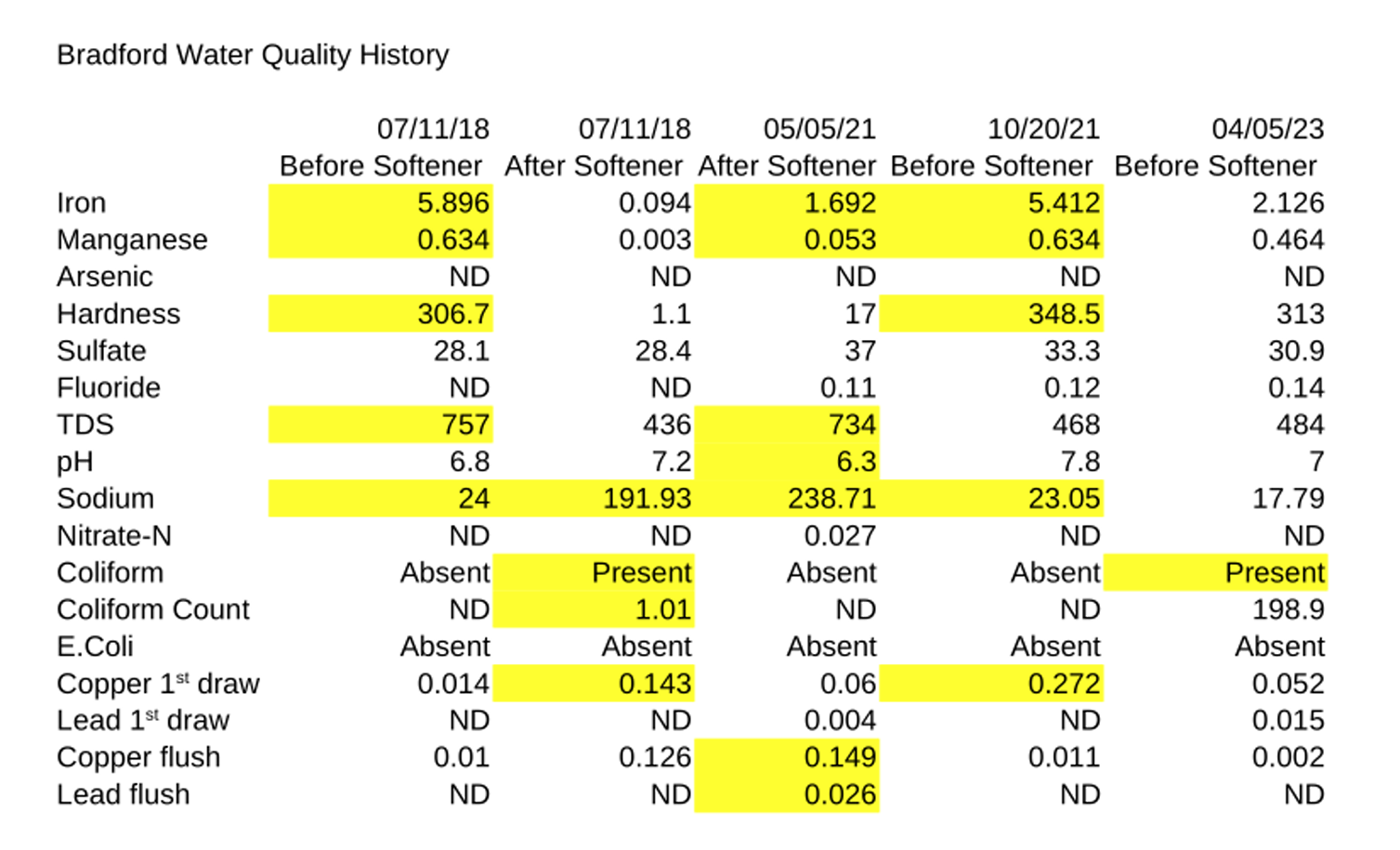
Not knowing any better, I learned to deal with these problems by setting the softener to regenerate every two days and to shock the well with chlorine quarterly. The following is an early history of tested water conditions taken before and after our ion-exchange water conditioner. Water contaminants concerns are highlighted:
Limitations of these Methods:
A softener can remove iron and manganese contaminants and soften the water. There is an advantage from an initial cost advantage in having only a softener as compared to adding oxidizing equipment. However, from a maintenance perspective, there is higher operating expenses when asking a softener to do all the work. A softener does not address bacteria.
- EPA estimates that a typical ion exchange softener uses about 25 gallons a day, or up to 10,000 gallons per year.
- In our case, to get the contaminants to levels less than EPA recommendations, it required the softener to regenerate (regen) every two or three days while consuming about one bag of salt a week. Shocking of the well requires about one quart of chlorine every time applied. –
- EPA is interested in the negative environmental impacts that salt and chlorine contribute to the environment. This is unregulated on a residential level.
Water Use Rates:
Our well pump and pressure tank are typical for a residence not connected to city water. The well pump is capable of providing about 8 gpm. The pressure switch starts the pump at 40 psig and stops it at 60 psi. I have not recorded annual water consumption since we bought the house. The WT-4 system includes a water meter and it reads a little over 30k gal for about year of operation.
Ozone Equipment Installed:
The equipment installed is the WT-4 Ozone Water Treatment System with as found on this site. The WT-4 includes an iron filter (FIOX). Equipment modifications were beneficial to meet our specific needs and desires as discussed later. I discovered that optimized equipment selection is highly dependent on water chemistry. There is no one-size-that-fits-all solution.
Water Treatment Test Results:
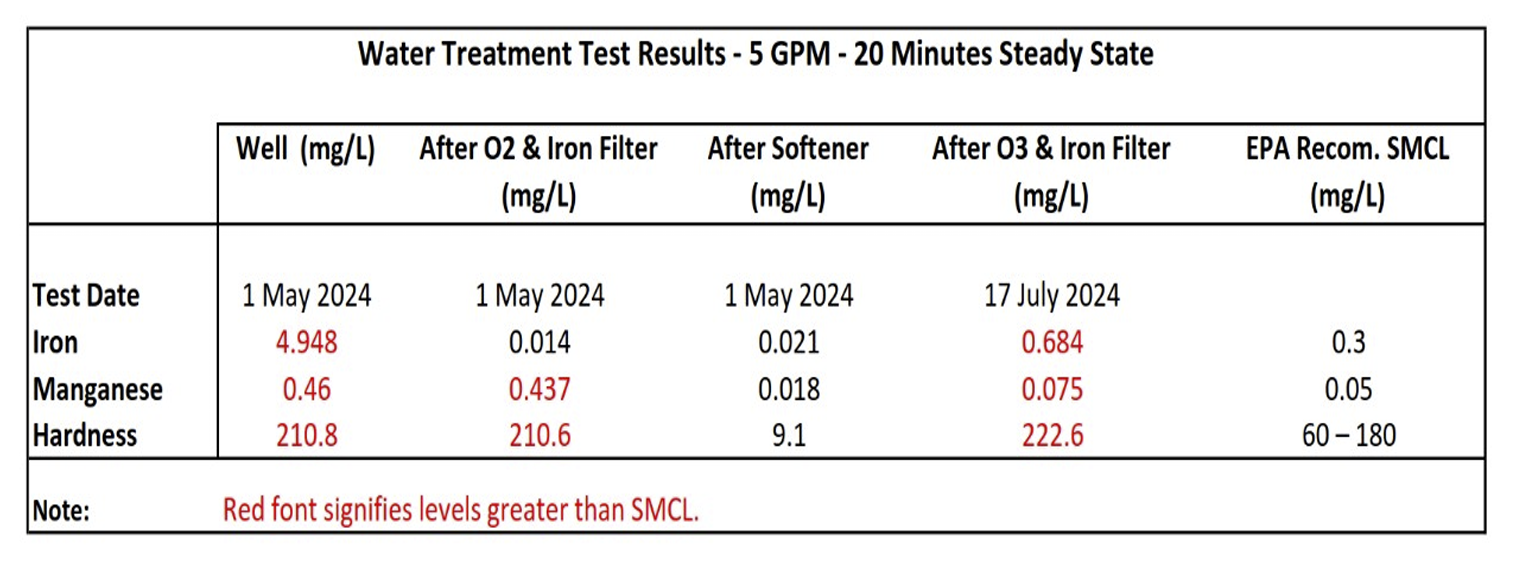
- The installed water treatment system (WT-4, FIOX and softener) reduces all the above contaminants to levels less than SMCL.-
- The ozone injection and iron filter do well at removing the majority of iron and manganese but does not meet SMCL without the softener. The softener primarily addresses hardness but when it is used after the WT-4 ozone injection and FIOX filter, it serves well to polish the water by removing residual iron and manganese.
- Only three of the 17 “contaminants” tested are listed here. These are considered nuisance contaminants and not usually considered a health risk.
- Reading the May test I was surprised that manganese had not been appreciably removed before the softener. Why? I discovered that the ozone generator had failed and only dry air was being injected into the water. I added a column above titled “After O3 & Iron Filter (mg/L)” to show the follow-up test with the ozone generator working. This July 2024 only tested water leaving the filter and before the conditioner. Since the conditioner had already proved capacity to remove higher levels of manganese in May, I did not retest water conditions leaving the conditioner in July.
I cannot explain why air did a better job of removing iron as compared to ozone and why air did not substantially remove manganese. Perhaps performing two separate tests on different days had something to do with it. In discussing these results with the technical point-of-contact (POC) at Oxidation Tech, John, he thought that the most probable explanation was that air did not have enough potential to oxidize manganese after oxidizing iron and that manganese is oxidized at a slower rate than iron.- During the steady-state test at 5 gpm, I measured a 0.5 mg/l ozone level in the water at the point-of-use (POU). For comparison, EPA allows a residual dissolved ozone concentration of 0.4 mg/L applied specifically to bottled water.
Modifications Made to the Standard WT System:
To properly describe the modifications, consider first the WT-4 system manual diagram below:
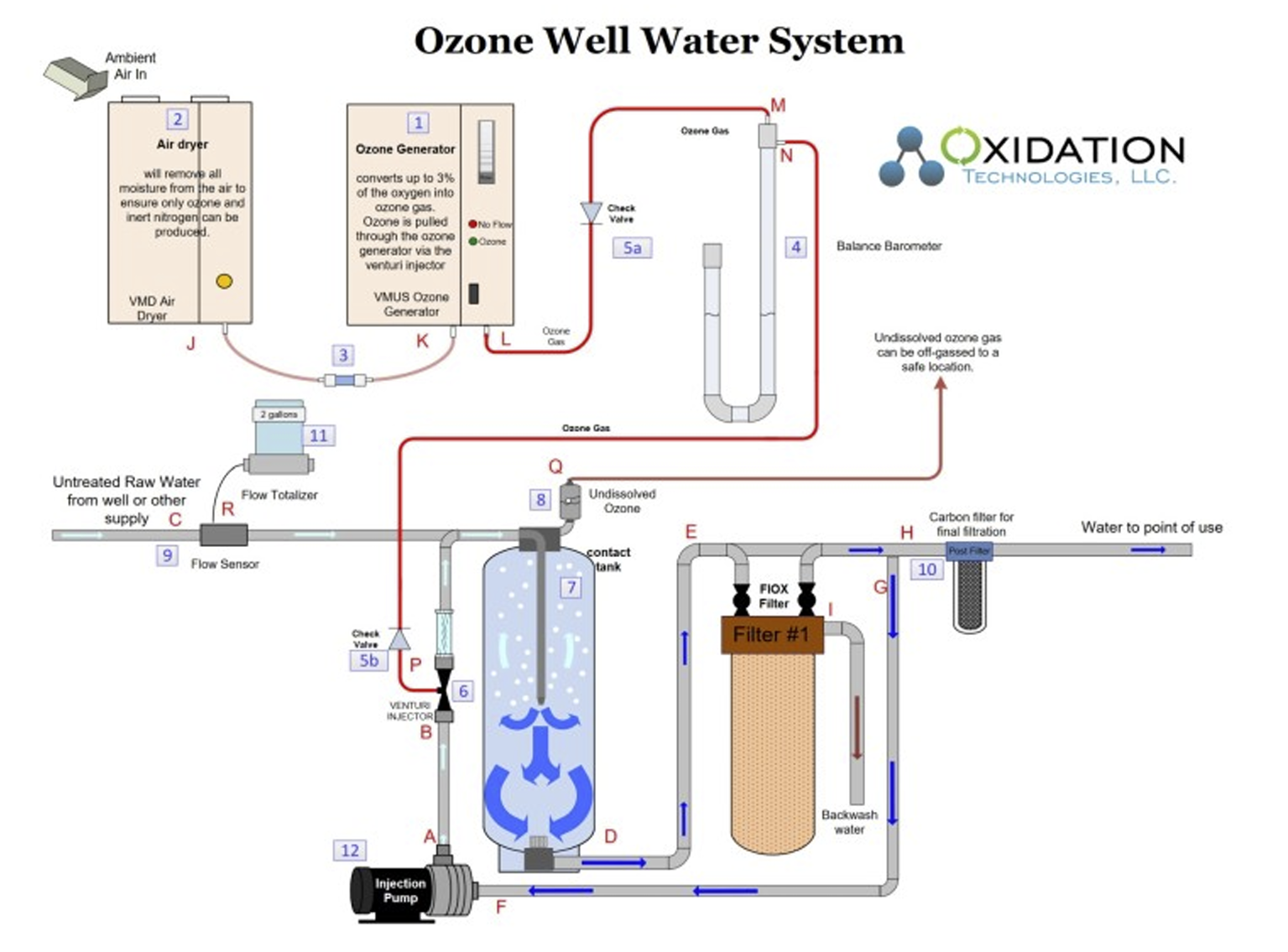
Here, untreated raw water is metered (for controlling ozone injection timing) and is mixed with treated water before entering into the contact tank. Assuming 8 gpm raw water and 8 gpm ozonated water, 16 gpm enters and leaves the contact tank and then enters and leaves the FIOX. Downstream of the FIOX the water path splits to send 8 gpm back to the pump (called a side-stream) and 8 gpm to the point-of-use. This simplified description of a hypothetical flow does not consider the more complex dynamics of pressure drops and the pump performance curves … but you get the idea. All the following modifications were discussed and confirmed with the Ozone Tech technical POC.
First, I requested, and Oxidation Tech agreed, to substitute a two-port head (instead of the above one port head) on the bottom of contact tank. This theoretically would reduce the friction and entry losses associated with 16 gpm entering the top of the contact tank.
Second, I relocated the flow sensor “R” downstream from point “H”. This was to keep the controller from injecting ozone during the FIOX regeneration process. Otherwise, you would be introducing water with oxidized iron when regenerating the FIOX.
Third, I upgraded to a quieter and larger pump. The WP-2 Injection Pump that comes with the WT-4 is subjectively too loud. In my opinion, the WP-2 is a good selection for a garage or remote room that is not adjacent to living areas. In my case, the location of the pump is in a finished basement and adjacent to a full bath and family room. The WP-2 pump noise was easily heard in these adjacent areas and on the top floor bedroom on quiet nights. The replacement pump is a Grundfos CM5-3 and is acceptably quieter. Oxidation Tech allowed a pump swap for the added cost of the new pump.
The justification for the larger/more powerful pump is debatable. A smaller pump like the WP-2 could meet most requirements, However, the next owner of this house with 3.5 baths might want a system capable of handling water requirements for a large family, at a maximum demand of 8 gpm. I relocated the pump as follows:
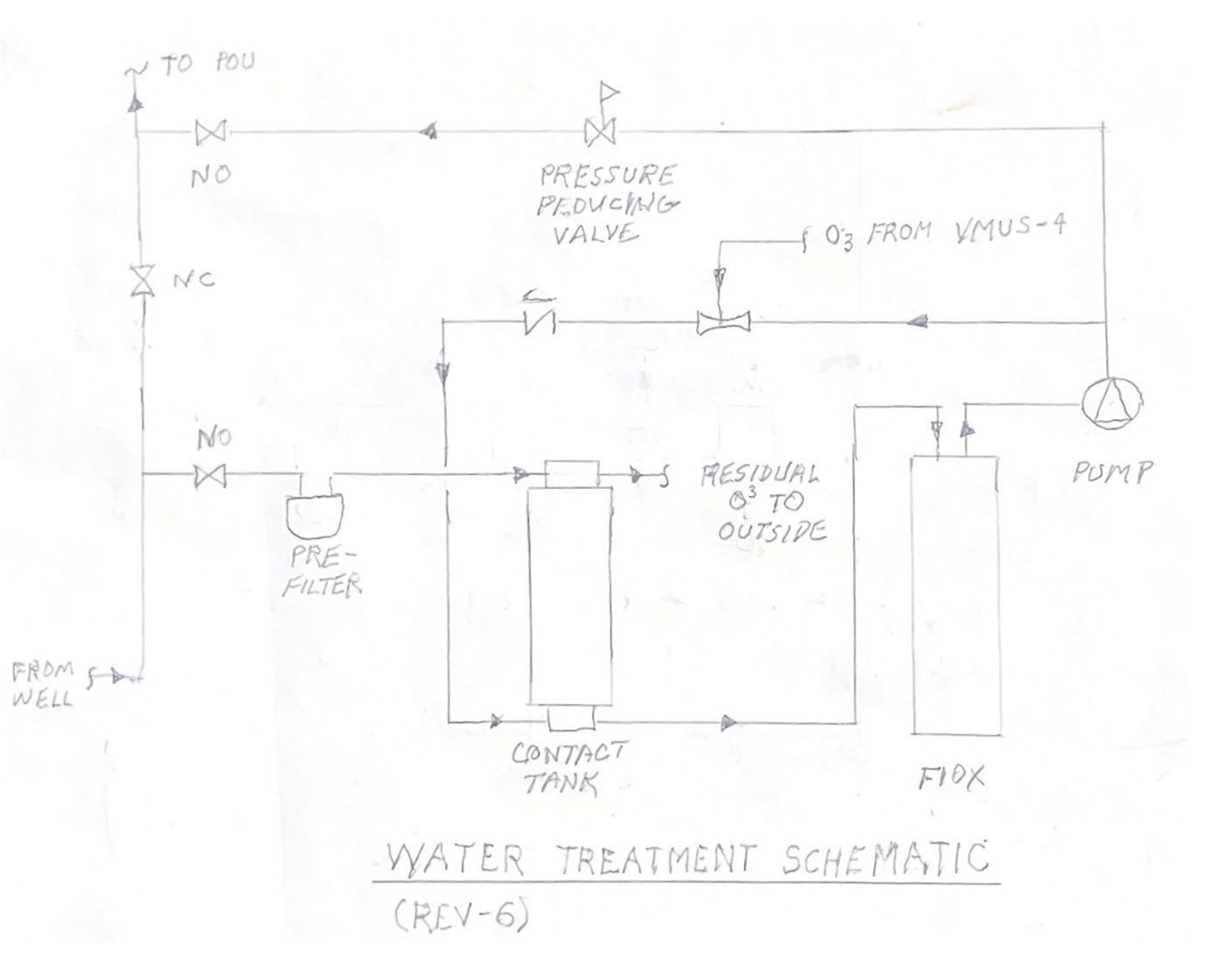
In this piping arrangement the pump supplies 80 psi to both the side stream (with the venturi) and the line (with the PRV) that directly feeds the POU.
I felt the need to relocate the pump primarily because in the unmodified piping arrangement I measured about a 10 psi pressure drop between the water well pump and the POU at a demand of 6 GPM. This resulted in lower water pressure on our top floor.
This modified arrangement overcomes the 10 psi pressure drop through the installed WT-4 system and maintains a constant pressure of 50 psi (adjustable) after the PRV, regardless of the pressure in the well pressure tank (not shown).Lastly, I added a check valve between the venturi and the contact tank. This assures that water does not bypass the FIOX when the pump is off and water is flowing to the POU.
Maintenance and Operation:
The installed WT-4 system has been operating without maintenance for nearly a year. The exception is when I replaced the ozone generator under warranty. This is a concern. Was this failure a result of shipping, for example, or a future reoccurring maintenance problem? Time will tell. Why Did I Choose Ozone Injection Technology: I came to understand that the water treatment industry is regulated on a industrial and municipality level but not on a residential level. It is entirely up to the residential home owner with a well and septic field to make sure their system is working and safe.
In seeking technical expertise on how to solve our water quality problem, many vendors held their technical “cards close to their chest.” The spectrum of first costs for the products included a water softener at the low end, chemical injection in the middle and recirculation ozone pump/venturi/tank/filter/softener arrangement at the high end of the spectrum.
The oxidizers and disinfection chemicals include Chlorine (with low annual costs) and hydrogen peroxide (with high annual costs). Chemical pumps are prone to frequent failures.
A popular choice with home owners is taking an iron filter and injecting or inducing an air bubble in the top of the tank to oxidize incoming water. Others claimed that air without disinfection would result in sludge that would form as a result of iron and/or sulfur reducing bacteria, eventually clogging the filter valve. To eliminate sludge some manufacturers add a UV light to address bacteria in the raw water before entering the iron filter. Further enhancing this, manufactures add an ozone generator to supply ozone to the bubble in the top of the tank after regen. Some reported that since ozone breaks down very quickly, eventually you are back to having just an air bubble, resulting in the same sludge problem. Although I have no experience with these systems, I don’t see how ozone added only at the filter regen could work for steady state or high water flow situations.
What eventually attracted me to Oxidation Tech was that its primary business is in the regulated industrial and municipality sector and with applications of the same technology into the unregulated residential water treatment. It seems to me that ozone water treatment in residential applications is a promising area. Because of the lack of customer’s experience in this area, I found myself relying on the experts in the field. I took this approach but with spot checking the math. I’m a mechanical engineer so delving into chemistry is a stretch for me. I spot-checked the science involved with the WT-4 because I felt a financial responsibility to make sure I wasn’t being sold magic.
Governing Standards and Design Perimeters:
Ozone in Water:
- In 1982, ozone was declared ozone “Generally Regarded As Safe” by the FDA, meaning it can be used in food products. This also applies specifically to bottled water, which also is under regulation by the EPA, allowing a residual dissolved ozone concentration of 0.4 mg/L. Title 21 of the Code of Federal Regulations under Part 165 describes the physical, chemical and other parameters for ozone in bottled water as a food product.
Ozone in Air:
- The FDA’s maximum allowed ozone concentration in the air for residential areas is 0.05 ppm ozone by volume.
- Detectable Odor: 0.01 to 0.04 ppm- TLV-TWA* 8-hour Limit: 0.10 ppm
- Headache, Shortness of Breath: > 0.10 ppm
- TLV-STEL** 15 Minutes: 0.30 ppm
- Chest Pain, Dry Cough, Lung Irritation, Severe Fatigue: 0.60 to 1.00 ppm, (1 to 2 Hours)
- Immediate Dangerous to Life and Death: 5.0 ppm
- Expected to Be Fatal: 50 ppm, (30 Minutes)
*TLV-TWA = Threshold Limit Value-Time Weighted Average. The level which a worker can be exposed to day-after-day for a working lifetime without adverse effects. ** TLV-STEL = Threshold Limit Value-Short-term Exposure Limit. The level which a worker can be exposed to up to 4 times per day with at least 60 minutes between exposures without adverse effects.
Design parameters:
- Avoid dangerous chemicals
- Low environmental impact
- Low maintenance.
- Cost-effective (capital, maintenance, operation)
Governing Equations:
0.43 ppm of ozone will precipitate out 1 ppm of iron
0.88 ppm of ozone will precipitate out 1 ppm of manganese
Ozone generator output (g/h) = Water Flow (gpm) x Dosage (ppm) x .228 1 ppm = 1 mg/l
Calculations:
For Iron = 8 gpm x 4.9 mg/l x (0.43 ppm ozone/1 ppm iron) x .228 = 3.84 g/hr
For Mn = 8 gpm x .46 mg/l x (0.88 ppm ozone/1 ppm iron) x .228 = 0.73 g/hr
Total: 4.58 g/hr. This is more than what the VMUS-4 ozone generator can provide. However, after ozone breaks down the remaining oxygen has oxidizing potential.
Pump Selection:
From the Mazzei venturi 584 selection chart for 80 psi inlet and 40 psi delta-P at 8 gpm, the venturi draws 7.1 SCFH or 3.3 l/min. At this air flow rate the performance table for the VMUS-4 shows an output of 1.9 g/hr.
Designing for 15 psi through the FIOX and connecting piping, or 55 psi load on the pump.
The Grundfos CM5-3 pump can provide 128 Ft head (60 psi) at 8 GPM.
You may notice the numbers are inconsistent but in the ball park and representative of the tested performance. I have learned that residential ozone water treatment system design has multiple parameters including water temperature, pH, ORP and other waste impurities. This is an area that seems to base equipment selection more on art than science. I found Oxidation Tech cooperative in optimizing the installed system.
Additional Performance Observations:
- Salt addition to the softener has been reduced from one bag per week (before ozone injection system) to one bag per eight weeks.
- Red and brown staining to laundered clothes, toilet bowls and shower tiles are eliminated.
- Occasionally there is a smell of ozone near the ozone injection system. Ozone level in the air has not been tested. I cannot explain why there is a occasional smell since there are no water leaks in the piping and undissolved ozone is vented to the outside. I intend to test the air in question for ozone with a ozone gas tester.
- Pump noise can be heard in an adjacent bath room to where the pump operates in the basement, but not in the living areas upstairs. The noise is not objectionable.
- No leaks in the wetted parts in contact with ozone injected water, including toilet fill valves.
- The ozone generator’s gas flow rate varies between 2.0 to 3.2 LPM depending on demand at the POU.
Cost:
- The ozone injection system’s first cost is greater than a softener alone or with an oxidation system such as chlorination and hydrogen peroxide (comparing advertised costs).
- System and associated materials cost about $6.5K including the slightly used $100 softener I found on craigslist.org. I chose and installed Schedule 80 CPVC pipe and fittings, but this was most likely overkill.
- My labor time was not recorded, but most likely was more than 60 hours. I would expect a master plumber could install it in under two days.
- Not having installed either a chlorine or hydrogen peroxide system, I cannot compare costs associate with chemical and labor costs to replenish these chemicals. From a safety perspective, I have concerns with bringing these chemicals into the house.
- Salt savings is about $300 annually, not including labor savings (and loss of exercise from not carrying salt bags).
- Electric costs are minimal because the unit runs about ten minutes a day … or about $10/year at $0.15/KWH.
- A proper cost analysis considers a person’s time worth. It takes time and money to add chemicals, replace failed equipment and it generally takes time and money to maintain a complex system. I’ve heard it said that maintenance is a gross engineering imperfection. On my part, I’ve adopted this thinking in part because I spent a few years of my career as Chief of Operations and Maintenance for a large R&D lab. The closer to zero maintenance, the better I like it.
The WT-4 Ozone Water System can be found HERE
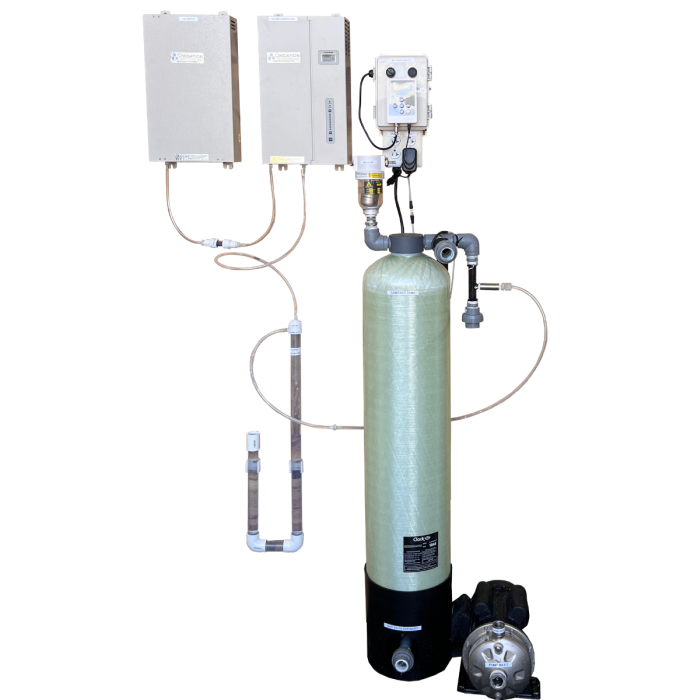
The FIOX Filter can be found HERE