What You Need to Know
Accurate ozone measurement is essential for safety monitoring, industrial control, and environmental compliance. But with several different sensor technologies available, it can be hard to know which one is right for your application. Below is a clear, engaging overview of the three most common ozone measurement methods — UV absorption, electrochemical sensors, and heated metal oxide sensors — along with their strengths, limitations, and ideal uses.
1. UV Absorption: The Gold Standard
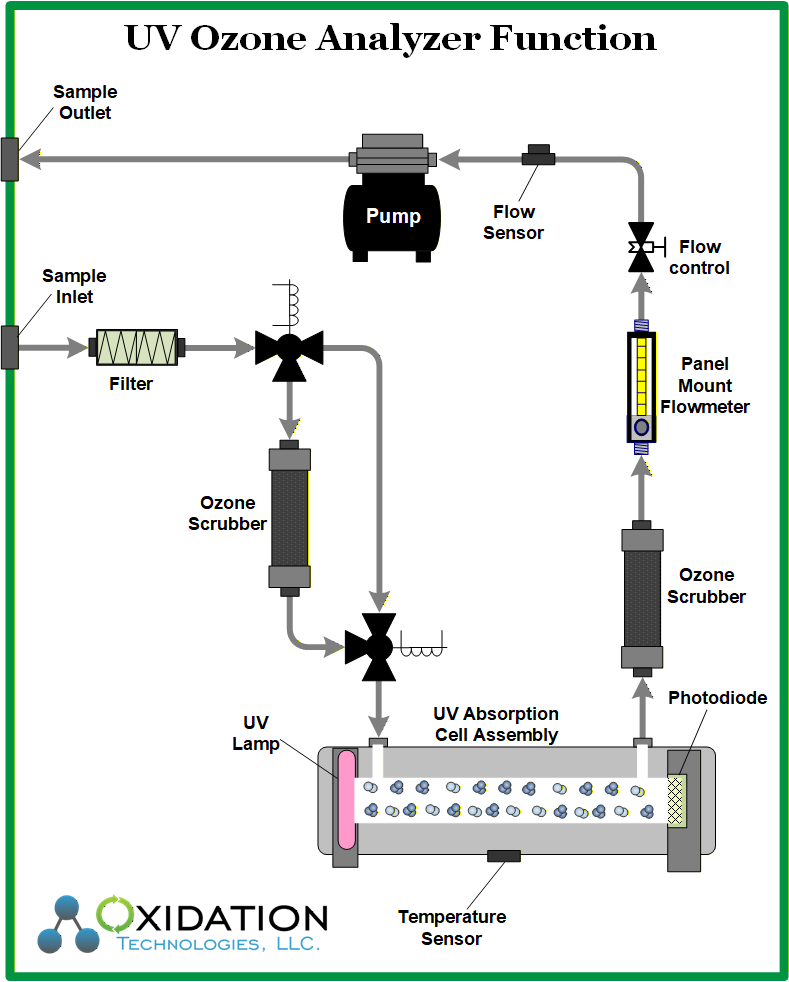
UV absorption analyzers are widely recognized as the most accurate method for detecting ozone. They work by shining UV light (usually at 254 nm) through a sample of air. Because ozone absorbs UV light, the analyzer measures how much the light intensity drops and calculates the exact ozone concentration.
Why it’s the top choice:
- Extremely high accuracy and stability
- Minimal drift over time
- Wide measurement range (from ppb to very high concentrations)
- Very low interference from other gasses
These analyzers are best suited for industrial process control, environmental monitoring, and regulatory compliance—anywhere precision truly matters. Although they require more upfront investment, they offer unparalleled reliability and long-term performance.
2. Electrochemical Sensors: Portable and Practical
Electrochemical sensors are commonly found in handheld ozone detectors and safety monitors. Ozone enters the sensor and reacts with an electrolyte, generating a small electrical current that corresponds to ozone concentration.
What makes them popular:
- Compact and lightweight
- Low power consumption
- Fast response time
- Great for personal exposure and ambient air monitoring
What to keep in mind:
- Sensor life is limited
- Can drift over time
- Sensitive to other oxidizing gases
If you need a portable, low-cost, or battery-powered ozone monitor, electrochemical sensors are a solid pick — just expect some maintenance and periodic sensor replacement.
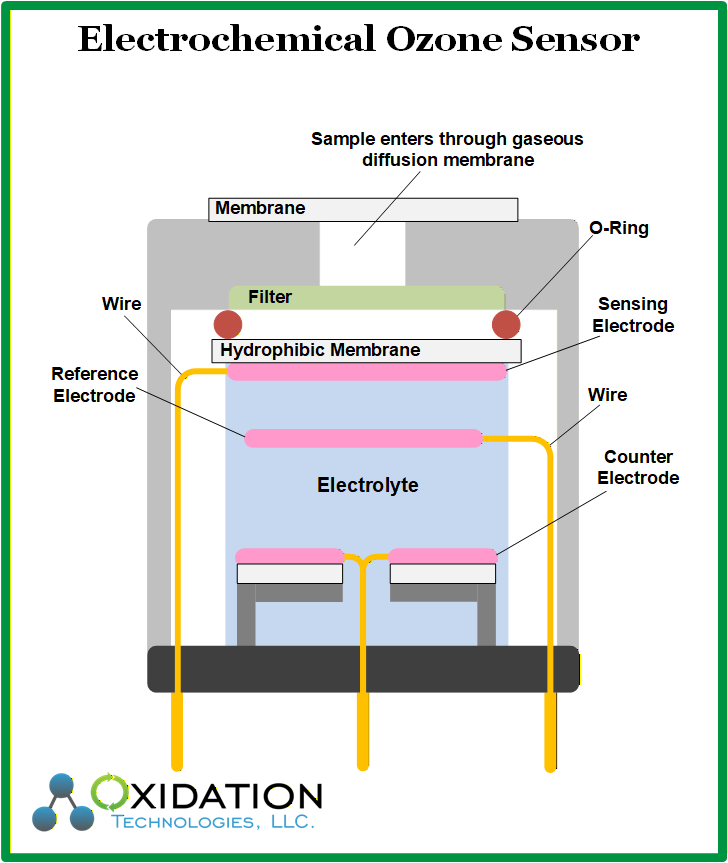
Operating Mechanism of Electrochemical Ozone Sensors
A typical electrochemical sensor contains:
Gas-Permeable Membrane
- Allows ozone to diffuse in while blocking particles, humidity, and contaminants.
Electrolyte Layer
- Provides the medium where the redox reaction occurs.
Three-Electrode Cell
- Working electrode: Ozone is reduced/oxidized here.
- Counter electrode: Balances the reaction.
- Reference electrode: Maintains a stable baseline potential for accurate readings.
Microcontroller / Signal Circuitry
- Converts the electrical current into ppm or ppb ozone readings.
3. Heated Metal Oxide Sensors (HMOS): Rugged and Durable
HMOS sensors use a heated metal oxide surface that changes resistance when ozone is present. These sensors are known for durability and strong performance in challenging environments.
Key advantages:
- Long-lasting and stable
- Fast response time
- Good for harsh or industrial conditions
- Low maintenance
Trade-offs:
- Accuracy is moderate
- Cross-sensitivity to other gases (especially VOCs)
- Not ideal for extremely high ozone concentrations
HMOS sensors shine in industrial safety systems, fixed installations, and environments where temperature and conditions fluctuate. They provide a reliable middle ground between electrochemical sensors and high-end UV analyzers.
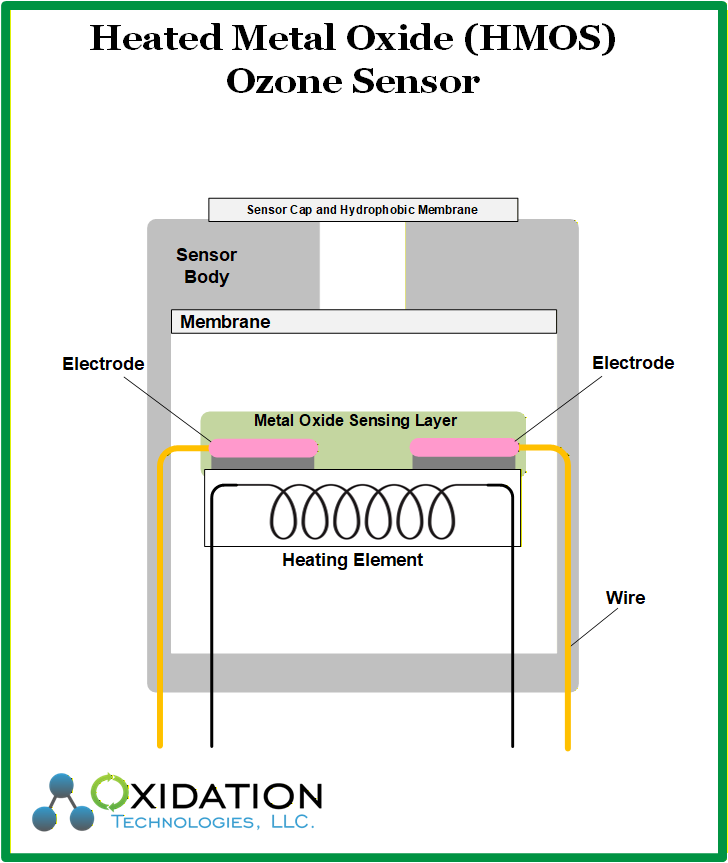
Operating Mechanism of HMOS Ozone Sensors
Integrated Micro-Heater
- Heats the metal oxide element to its operating temperature (typically 200–400°C).
Metal Oxide Sensing Layer
- Exposed directly to the ambient air or sampled gas stream.
Ozone Interaction
- Ozone, being a strong oxidizer, reacts on the sensor surface and alters the charge carrier density.
Resistance Change Measured
- The electronics detect the change in resistance and translate it into a concentration signal.
How to Choose the Right Ozone Measurement Method
When selecting ozone measurement equipment, consider the following:
Accuracy Needs
- Choose UV absorption if precision is critical.
- Choose electrochemical or HMOS for general monitoring or safety alarms.
Portability
- Electrochemical sensors are the best fit for handheld or wearable devices.
- UV analyzers are generally stationary.
Environment
- HMOS sensors handle tough, rugged conditions.
- Electrochemical sensors work best in clean, controlled environments.
- UV analyzers are great for labs and industrial control rooms.
Maintenance
- UV analyzers require minimal ongoing maintenance.
- Electrochemical sensors need periodic replacement.
- HMOS sensors last longer but need calibration consideration.
Final Thoughts
Every ozone measurement method serves a unique purpose. The “best” option depends on your accuracy requirements, environment, and whether mobility or ruggedness is important.
- UV absorption analyzers offer unmatched precision and stability.
- Electrochemical sensors are ideal for portable, everyday monitoring.
- HMOS sensors provide rugged durability for industrial settings.
Understanding these differences helps ensure that your ozone monitoring system is reliable, safe, and tailored to your specific needs.

Calibration
View our calibration page for:
- Calibration Frequency
- Calibration Costs
- The RMA Process
- Calibration Service Request Form
- Calibration Certificate
- Field Calibration Products

We offer additional gas detection products in partnership with our subsidiary, Gas Sensing. For gasses other than ozone view the Gas Sensing website.
Sensor Comparison Chart
| Category | UV Absorption Analyzer | Electrochemical Sensor | Heated Metal Oxide (HMOS) Sensor |
| Measurement Method | Measures absorption of UV light at 254 nm using Beer–Lambert Law | Measures electrical current from ozone redox reaction in electrolyte | Measures resistance change of heated SnO₂ surface exposed to ozone |
| Accuracy | Very high accuracy (up to 1%) | Moderate, 10% accuracy | Moderate, up to 5% for liminted ranges, 10% typical |
| Drift Over Time | Minimal drift, continuous zero reference | Drift due to electrolyte consumption | Minimal drift, no consumable electrolyte |
| Consumable Components | None (UV lamp only) | Electrolyte is consumed by ozone | None (no electrolyte, no moving parts) |
| Sensor Life | UV-Lamp life of ~3-5 years | 6-months to 3-years | 2-5 years |
| Measurement Range | ppb to 25% wt / 500 g/m³, broadest measurement range | ppm range | ppb detection with upper range suited for ambient safety |
| High Level Ozone Tolerance | Excellent — no sensor damage | High ozone shortens sensor life | Good, no sensor life changes, limited accuracy of high ozone levels |
| Cross Sensitivity | Minimal — unaffected by oxidizing gases | Cross-sensitive to oxidant gases (NO₂, Cl₂, etc.) | High cross sensitivity to VOCs along with oxidant gasses |
| Humidity & Temperature Effects | Temperature and Humidity compensated | Sensor performance most affected by humidity & temperature | Wide operating temperature range due to internal heater, less affected by humidity than Electrochemical sensors |
| Power Requirements | Line-powered instrument | Ultra-low power, battery friendly | Low power, can be battery operated |
| Response Time | 10+ Seconds | Very fast (< 10 seconds) | Very fast (< 10 seconds) |
| Calibration Requirements | On-site calibration possible | Sensor can be replaced or shipped easily for calibration. Frequent ozone exposure will require more frequent calibration | Sensor can be replaced or shipped easily for calibration. |
| Portability | Fixed or benchtop use | Excellent for portable & wearable devices | Excellent for fixed long-term ozone detection, can also be battery powered and portable. |
| Regulatory Acceptance | EPA accepted for ambient ozone | Safety use only | Safety use only |