
by John Huizenga
In this experiment with nanobubble generating equipment we will use a simple green laser to evaluate several methods of generating nanobubbles. A green laser light is an excellent method of determining the presence of nanobubbles in water and a general idea of more nanobubbles or less nanobubbles when compared to a similar sample. When a green laser beam shines through water, the laser light reflects off the microscopic bubbles, and you are able to see the beam natively with no additional equipment needed. This phenomenon is similar to effect of a beam of sunlight shines through a dusty room
Principles of analysis:
- A visibly brighter beam indicates a higher concentration of nanobubbles or nanoparticles in the water.
- Duration of nanobubble presence confirms bubbles that do not float to the surface.
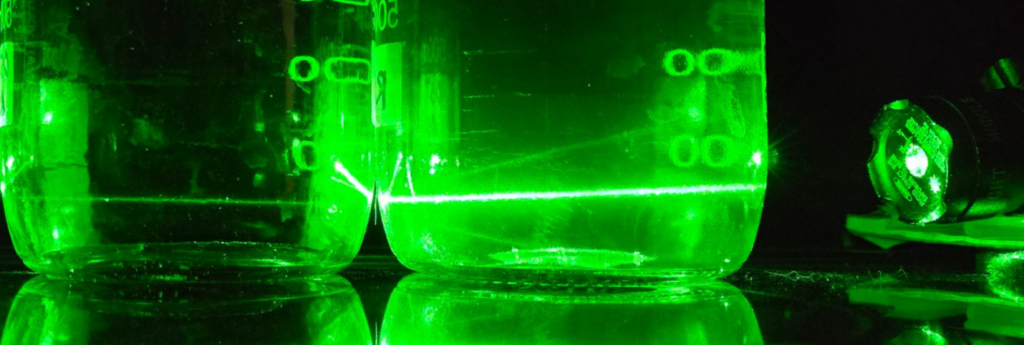
The photo below demonstrates the first principle. With a green laser beam shining through two water samples, the faint beam appearing in the left sample indicates a low concentration of nanoparticles, and the bright beam on the right sample indicates a high concentration of nanoparticles.
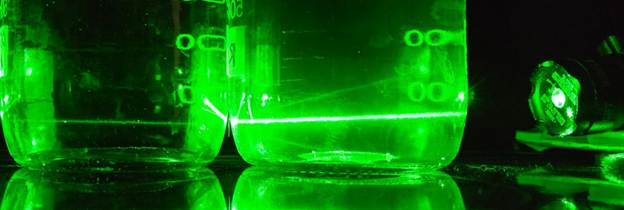
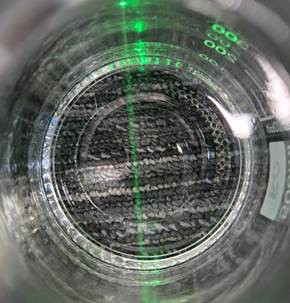
Figure 1: Laser light passes through the water with minimal visible light showing.
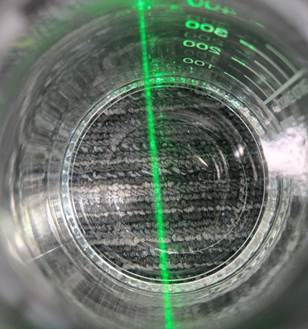
Figure 2: Laser light reflects of nanobubbles and is more visible in water.
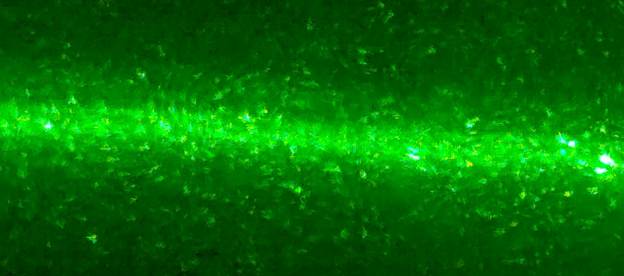
Figure 3: A close-up view of this bean shining through water and reflecting off tiny particles.
Equipment used to generate nanobubbles for the first test:
- 1hp pump circulating water for 1 minute from a stainless steel tank with 5 gallons of tap water through a static mixer with 3 LPM oxygen/ozone injected at the pump outlet several inches ahead of the static mixer.
- 1hp pump circulating water for 1 minute from a stainless steel tank with 5 gallons of tap water through an electrocoagulation and cavitation nanobubble device with 3 LPM oxygen/ozone injected at the pump outlet several inches ahead of the static mixer.
- 1hp pump circulating 5 gallons of tap water for 1 minute through the Oxidation Technologies OST injection skid tank using a Mazzei 784 venturi with 3 LPM oxygen/ozone injected venturi suction port. Water loop under 30 psi of pressure.
At the end of the treatment, water samples were drawn off and an hour later the green laser was used on each sample.
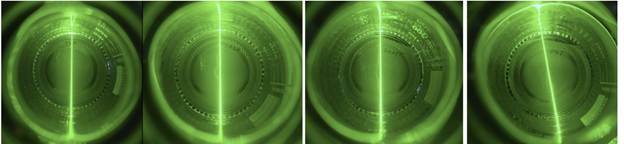
As you can see in the picture below, the laser beam test suggested a high concentration of nanobubbles for all of the samples and the results were not very helpful in verifying the presence of nanobubbles. The problem is that tap water contains many nanoparticles that reflect the laser beam. Reverse osmosis water removes most of these particles so we use reverse osmosis water instead of tap water in the next test.
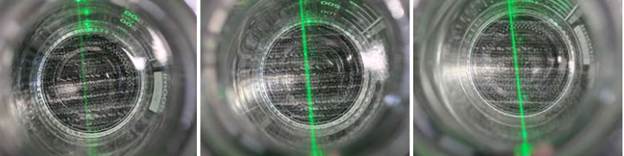
I did the same test over again, this time using reverse osmosis water. This time there was a clear difference between the samples:

Even 10 days later we see a clear distinction between the reverse osmosis water control, water treated with the electrocoagulation and cavitation device, and water treated with our OST system. The only thing added to the water was oxygen and ozone gas. The reflection of green laser light indicates the presence of bubbles/particles that neither settled out of solution nor floated to the surface.
There are a number of different methods used to create nanobubbles. Oxidation Technologies has many years of experience dissolving ozone into water and generating nanobubbles with reliable and effective equipment. The most important matter to us is to thoroughly understand your goals with water treatment. When we understand your goals and the water problem you are dealing with, we are able to determine how ozone can best be implemented to help you reach your goals.
You can read more about nanobubbles here:
https://www.oxidationtech.com/applications/water-treatment/ozone-nanobubbles.html
https://www.oxidationtech.com/ozone/ozone-basics/ozone-nanobubble-review.html
John Huizenga
Sales and Service Rep
Oxidation Technologies, LLC.
214 W Highway 18
Inwood, IA 51240
Direct Phone: (515)-635-5854 x1010
Toll Free: (844)-398-9579
[email protected]
www.oxidationtech.com