
Ozone Applications

CT Value
CT Value – What is it?
CT Value is a common term used to quantify disinfection dosage rates in water. CT refers to Concentration of the disinfectant in water and the exposure time of that disinfectant. Or can be communicated as Concentration over Time, C/T = final CT value.
In the world of ozone “CT” is the product of “residual disinfectant concentration” (C) in mg/l of ozone, and the corresponding “disinfectant contact time” (T) in minutes. It is important to note the ozone concentration should be measured at the end of a contact tank, or loop to determine the ozone concentration present. In other words, for ozone CT, it is the dissolved ozone concentration multiplied by the contact time.
(remember that 1 mg/l = 1 PPM)
Quick Examples:
1 mg/l Ozone residual for 1-minute of time = CT of 1
2 mg/l Ozone residual for 1-minute of time = CT of 2
1 mg/l Ozone residual for 1-minutes of time = CT of 2
Some sanitizing treatments with ozone can be accomplished very quickly, but some treatments will require sufficient ozone in the water along with a sufficient contact time. This contact time is required for the dissolved ozone to oxidize organic contaminants and to disinfect the water.
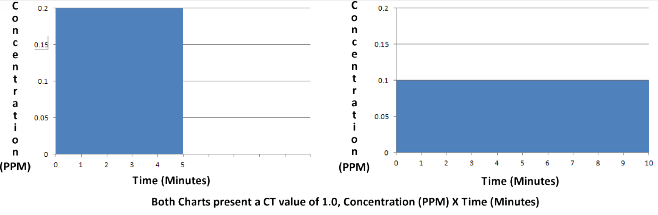
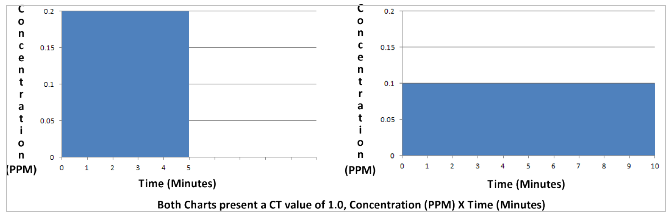
This CT value is assumed to be a constant, but either the C can be held constant while the T is varied, or visa-versa, to assure a given level of disinfection is obtained.
For example, if a drinking water disinfection plant requires a CT value of 1.6. This actually means the dosage rate is 1.6 mg/l minutes. The operator has a choice of ozonating at 0.2 PPM for 8 minutes or 0.4 PPM for 6 minutes. It is up to them as long as the final dosage rate is 1.6.
Expert Fact:
You may have heard the claim, “ozone is 3,000x more germicidal than Chlorine”. What does this mean?
This statement hinges on the fact that for some organisms, you need a CT value 3,000x higher when using chlorine vs. ozone. Put another way, if a dissolved ozone level of 0.2 mg/l for 1 minute (CT – 0.2) is needed to inactivate a specific microorganism, you will need 200 PPM of chlorine for 3 minutes (CT = 600) to achieve the same kill effect.